You’ve got a 1970s ranch house with that classic San Diego single-story layout—sloping ceilings, a brick fireplace that hasn’t been touched since disco died, and windows that let in all the heat but none of the breeze. You want to remodel it, but you’re also tired of watching your SDG&E bill climb every summer. So you start Googling “eco-friendly remodeling San Diego” and suddenly you’re drowning in jargon: Title 24, solar mandates, gray water systems, cool roofs. It’s a lot.
Here’s the short version of what you actually need to know: San Diego’s climate is your biggest asset, but its building codes are your biggest hurdle. If you plan your remodel around solar readiness, water efficiency, and the state’s energy code, you can cut your utility bills by 30–50% and add real resale value. But if you ignore these things until after the drywall goes up, you’ll be paying for expensive retrofits or, worse, failing inspection.
We’ve been through this dozens of times with homeowners across North Park, Normal Heights, and Point Loma. The mistakes are almost always the same. Here’s what we’ve learned.
Key Takeaways
- San Diego’s Title 24 energy code applies to most major remodels, not just new construction.
- Solar panels are not required on every home (yet), but your roof and electrical panel must be “solar ready.”
- Water conservation upgrades—like high-efficiency fixtures and gray water plumbing—pay back faster than solar in many cases.
- The biggest mistake? Choosing finishes before understanding how the building envelope performs.
- A well-planned eco-remodel can increase home value by 10–15% in San Diego’s market, according to local appraisers we work with.
Table of Contents
The Reality of Title 24 in a Remodel
If you’re tearing out more than 50% of your exterior walls or doing a full kitchen and bath gut, you’re almost certainly triggering Title 24 compliance. This isn’t a suggestion—it’s California law, and San Diego County enforces it aggressively.
What that means practically: your architect or designer needs to run energy models before you pick out tile. The code cares about your insulation levels, window U-values, duct sealing, and lighting efficiency. We’ve seen homeowners fall in love with a massive south-facing window wall only to discover it blows their energy budget and forces them to install expensive triple glazing or extra solar capacity.
The workaround isn’t to fight the code—it’s to design with it from day one. For example, in a recent La Mesa project, we shifted the kitchen to the north side of the house and added deep eaves on the south. The energy model passed on the first try, and the homeowner saved about $4,000 on mechanical upgrades they would have needed otherwise.
What Actually Triggers Compliance
It’s not just about square footage. Here’s the practical breakdown from what we’ve seen in the field:
| Trigger | What It Means | Common Mistake |
|---|---|---|
| Altering >50% of exterior walls | Full envelope compliance required | Assuming “just a few new windows” doesn’t count |
| Replacing all windows | Must meet Title 24 window U-factor and SHGC standards | Buying standard Low-E glass that doesn’t meet California specs |
| Adding or replacing HVAC system | Must meet efficiency requirements and duct sealing | Not factoring in duct leakage testing |
| Kitchen or bath remodel with new lighting | Must use high-efficacy fixtures or dimmers | Installing recessed cans without IC-rated insulation covers |
| Adding a bathroom or bedroom | Triggers whole-house solar readiness | Forgetting to run conduit during the rough-in |
The takeaway? Get a Title 24 consultant involved before you sign a contract with a contractor. It costs a few hundred dollars and saves thousands in change orders.
Solar: Not Just About Panels on the Roof
Everyone thinks “eco-friendly remodel” means slapping solar panels on the roof and calling it a day. That’s a mistake. San Diego’s solar mandate (California’s 2020 requirement for new homes) technically applies to new construction and major additions, but any remodel that adds a new room or increases square footage by more than a certain threshold will require a solar-ready roof.
Here’s what “solar ready” actually means in practice: your roof needs to be oriented within 45 degrees of south, have at least 250 square feet of unobstructed space, and your main electrical panel needs to have space for a solar breaker. If your house was built before 2000, your panel probably doesn’t have room. We see this all the time in older Mission Hills homes.
The Real Cost Trade-Off
Installing solar during a remodel is cheaper than doing it later. The labor is already there, the roof is already exposed, and you can bundle the cost into your construction loan. But here’s the honest truth: not every San Diego home is a good solar candidate. If you have a lot of shade from eucalyptus trees or a north-facing roof, the payback period stretches to 12–15 years. In those cases, we’ve advised homeowners to skip solar and instead invest in a heat pump water heater and a smart electrical panel that can manage time-of-use rates.
One customer in University Heights had a beautiful flat roof but terrible southern exposure. We put in a solar-ready conduit for future use and focused on a high-efficiency mini-split system instead. They cut their cooling bill by 40% without a single panel.
Water Conservation: The Overlooked Payoff
San Diego gets about 10 inches of rain a year. We’re in a semi-arid climate, and water rates have tripled over the last decade. Yet most remodels completely ignore water conservation beyond swapping out a low-flow showerhead.
A truly eco-friendly remodel in San Diego should address three things: indoor fixtures, outdoor irrigation, and gray water potential.
Indoor: Beyond Low-Flow
The standard California low-flow toilet uses 1.28 gallons per flush. That’s fine, but dual-flush models (0.8/1.28) actually perform better in our experience—they clog less often and use less water overall. For showers, look for 1.75 GPM heads with good pressure. We’ve found that the WaterSense-labeled models from brands like Delta and Moen hold up better to San Diego’s hard water than the cheap builder-grade stuff.
Outdoor: The Real Water Hog
Most San Diego homes use 50–70% of their water outdoors. If you’re remodeling and have any landscaping plans, this is where you can make a huge dent. We recommend installing a separate irrigation meter (SDG&E offers rebates for this) and switching to drip lines instead of spray heads. One client in Kensington cut their water bill by $80 a month just by swapping out their lawn for native plants and drip irrigation.
Gray Water: Not as Scary as It Sounds
Gray water systems let you reuse water from your bathroom sinks, showers, and washing machine for irrigation. San Diego County has relatively permissive gray water codes for simple “laundry-to-landscape” systems—no permit required if you follow the guidelines. We’ve installed these in a dozen remodels now, and they’re surprisingly simple. The key is to run a separate drain line during the rough-in plumbing phase. If you wait until after the slab is poured, it becomes a demolition project.
The Building Envelope: Where Most Remodels Fail
Here’s the thing nobody tells you: you can put the most efficient HVAC system and the best solar panels on the planet, but if your house leaks air like a sieve, you’re wasting money. San Diego’s mild climate makes people lazy about insulation. We see homes in Ocean Beach with original single-pane windows and zero attic insulation.
A proper eco-remodel starts with the building envelope. That means air sealing, insulation, and window upgrades. In San Diego, the biggest heat gain comes through the roof and west-facing windows. We’ve had great results with spray foam in attics (R-38 or higher) and low-e coatings on west-facing glass.
One job in Hillcrest: the homeowner wanted to keep their original wood casement windows for the look. We compromised by adding interior storm panels with low-e glass. They kept the historic aesthetic and cut their cooling load by 25%. Not every solution has to be all-or-nothing.
The Insulation Trap
Don’t assume that more insulation is always better. In San Diego’s coastal areas, too much vapor-impermeable insulation can trap moisture and cause rot. We’ve seen it happen with closed-cell spray foam in older homes that don’t have proper vapor barriers. Stick to open-cell foam or dense-pack cellulose for most retrofits, and always run a moisture analysis if your house was built before 1960.
Materials: What Actually Holds Up
Eco-friendly materials sound great on paper, but they have to survive San Diego’s real conditions: intense UV, dry heat, coastal salt spray (if you’re near the water), and occasional Santa Ana winds. We’ve learned the hard way which products don’t last.
Flooring
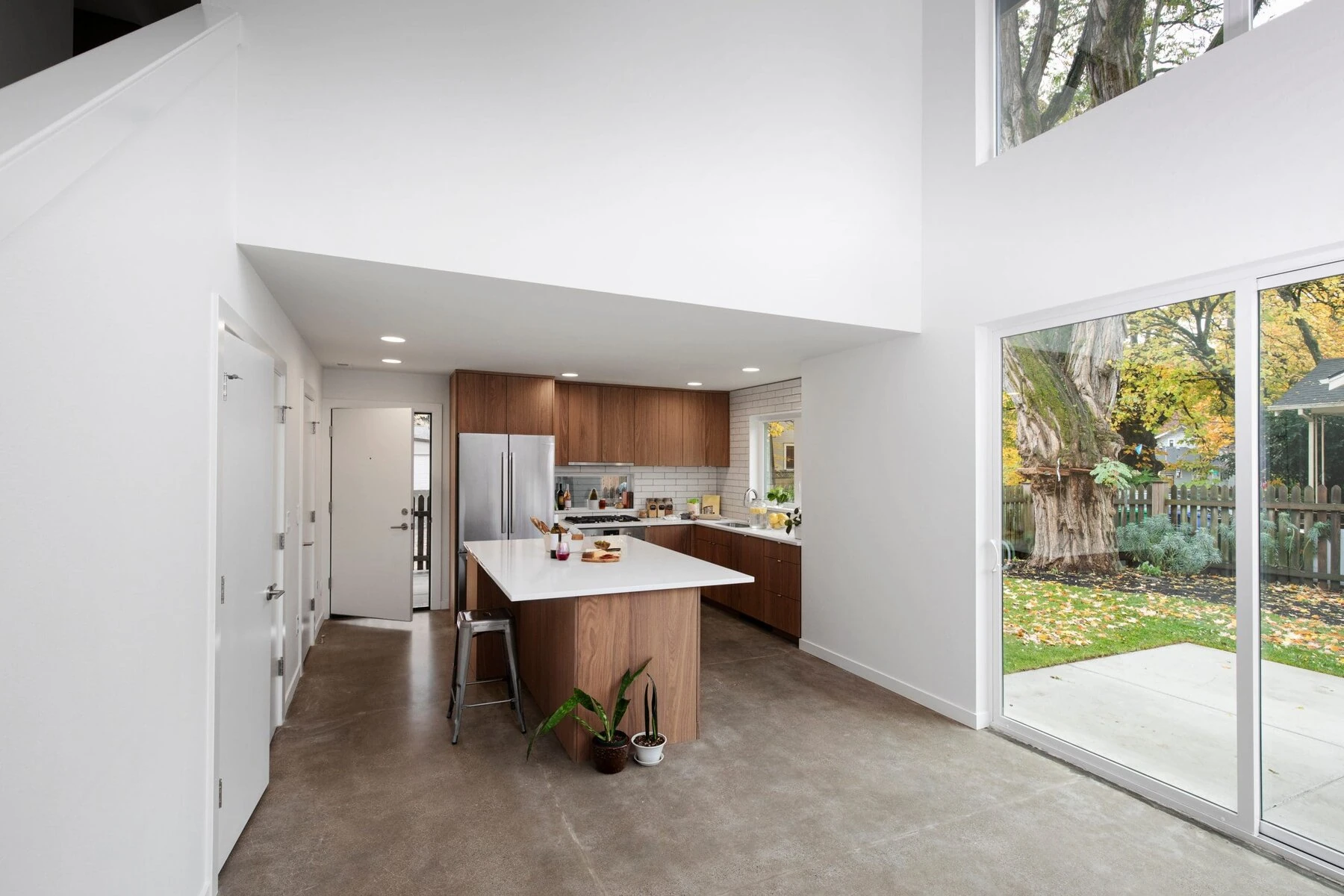
Bamboo is popular but warps in humidity. Cork is comfortable but fades in direct sun. Our go-to for eco-friendly remodeling in San Diego is luxury vinyl plank (LVP) made from recycled content, or polished concrete if the budget allows. LVP handles the temperature swings, doesn’t absorb moisture, and can be recycled at end of life. Concrete is even better if you have existing slab—it’s already there, and you can stain it with low-VOC products.
Countertops
Recycled glass countertops look beautiful but scratch easily. Quartz is durable but energy-intensive to produce. We’ve settled on paperstone (a compressed paper composite) for most projects. It’s renewable, locally available, and holds up to heat and knives better than you’d expect. It’s not cheap, but it lasts.
Cabinetry
Plywood boxes with formaldehyde-free MDF doors are the sweet spot. Avoid particleboard—it swells in San Diego’s humidity spikes. We’ve had good luck with local mill shops that use FSC-certified wood.
The San Diego Factor: Climate, Codes, and Common Sense
Living in San Diego gives us a unique advantage for eco-friendly remodeling. We have 260 sunny days a year, mild winters, and a progressive building code that pushes innovation. But that same mild climate makes people complacent. We see homeowners skip insulation because “it never gets that cold,” then wonder why their AC runs all summer.
The real trick is to design for San Diego’s specific microclimates. A house in El Cajon (hotter inland) needs different strategies than one in Pacific Beach (cooler, salt air). We always recommend a blower door test before starting any remodel—it tells you exactly where your house leaks. That $400 test has saved our clients thousands in oversized HVAC equipment.
When to Call a Professional
If you’re just swapping out a faucet or painting a room, you don’t need us. But if you’re planning any structural work, electrical panel upgrades, or window replacements, hire a contractor who understands Title 24 and solar readiness. We’ve seen too many DIY homeowners install beautiful windows that fail inspection because the U-value is wrong for California. That’s a $5,000 mistake.
At Golden Shore Design & Build, we handle eco-friendly remodeling in San Diego every day. We know the local inspectors, the rebate programs, and the suppliers who actually stock the right materials. If you’re in North Park, Mission Hills, or anywhere in the county, we can walk your property and tell you what’s worth doing and what’s a waste of money.
The Bottom Line
An eco-friendly remodel in San Diego isn’t about following a trend—it’s about making your home work better in this specific climate. Focus on the building envelope first, then water conservation, then solar readiness. Don’t chase every green certification; chase performance that you can measure in lower bills and fewer repair calls.
The best projects we’ve done are the ones where the homeowner understood that “eco-friendly” isn’t a checkbox—it’s a design philosophy that starts with how the sun hits your roof and ends with how much water your garden drinks. Get that right, and everything else falls into place. Get it wrong, and you’re just putting lipstick on a pig.
If you’re ready to start planning, give us a call. We’ll be honest about what’s worth doing and what’s not. That’s the only way to build something that lasts.
Related Articles
5 Coastal Design Mistakes Quietly Draining San Diego Homeowners — And Exactly How to Fix Them
San Diego ADU Construction: Fast-Track Your Build & Avoid Costly Mistakes
People Also Ask
The San Diego Solar Equity Program is a city initiative designed to make solar energy accessible to low- and moderate-income homeowners. It offers financial incentives and support to reduce upfront costs, helping eligible residents install solar panels on their homes. This program aims to lower electricity bills and promote renewable energy adoption across San Diego neighborhoods. For homeowners in Chula Vista, National City, La Mesa, and Spring Valley, similar local programs may be available. At Golden Shore Design and Build, we can guide you through the application process and ensure your solar installation meets current industry standards and local requirements for maximum efficiency and savings.
For homeowners in San Diego, selecting a top-tier solar company involves evaluating installation quality, panel efficiency, and long-term service. Leading local providers often include SunPower, Tesla, and Vivint Solar, each offering robust warranties and high-performance panels. However, the best choice depends on your specific roof type, energy usage, and budget. Many San Diego residents also work with smaller, certified local installers who provide personalized service and faster response times. When comparing companies, always verify their California contractor license, read recent customer reviews, and request multiple quotes. A reputable installer will conduct a thorough site assessment and explain net metering policies. For a seamless experience, Golden Shore Design and Build recommends focusing on companies that offer comprehensive warranties and have a proven track record in San Diego's climate.
Golden Shore Design and Build understands that for businesses in San Diego, Solar Turbines represents a major industrial and employment anchor. While we specialize in residential and commercial design and construction, we recognize that the presence of large manufacturers like Solar Turbines creates demand for nearby housing and commercial spaces. For homeowners or business owners in San Diego, Chula Vista, National City, La Mesa, and Spring Valley, we recommend considering how industrial zones influence property values and development potential. Our team can provide general guidance on how to plan projects that complement the local economic landscape, ensuring your property meets both aesthetic and functional standards.