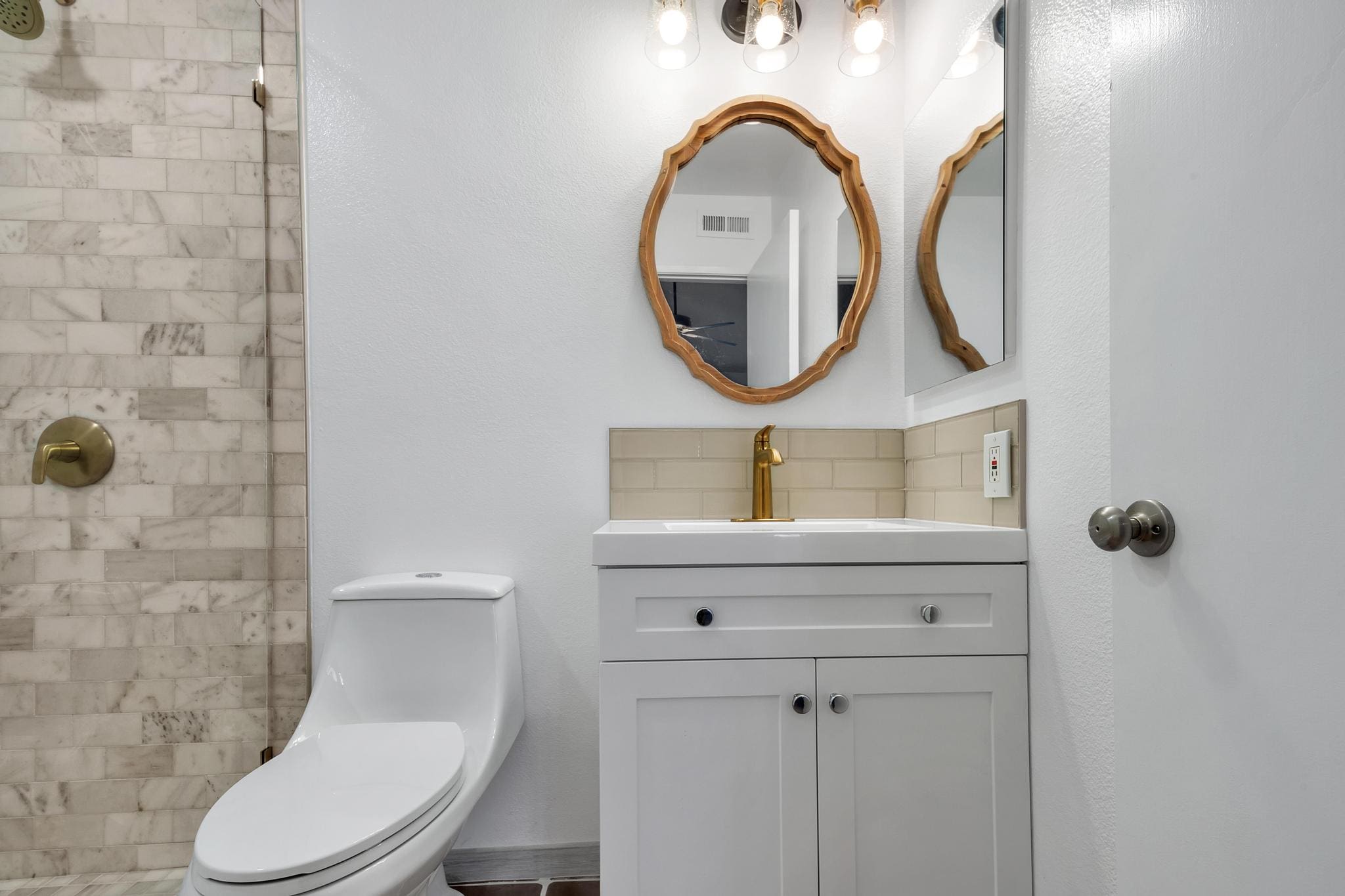
Key Takeaways: The “golden rule” of bathroom design isn’t about a single measurement. It’s about creating a safe, functional, and comfortable space where everything works in harmony. This means prioritizing clearances, smart fixture placement, and understanding that the best layout is the one that fits your life, not just a textbook diagram.
We’ve walked into hundreds of bathrooms over the years, from stunning Mission Beach remodels to cramped 1920s bungalow bathrooms in North Park. And the single most common planning mistake we see isn’t a style choice—it’s a fundamental misunderstanding of space. Homeowners get fixated on the dream tub or a double vanity, but they haven’t first asked: “Can we actually move in here?”
So, let’s talk about what mastering bathroom layouts really means. It’s less about rigid rules and more about a set of practical principles that prevent daily frustration.
What is the core principle of a functional bathroom layout?
The core principle is creating clear, unobstructed zones for each activity. You need a clear path to enter, space to stand at the vanity, room to use the toilet, and safe access to the shower or tub. This is governed by building codes (which are minimums) and comfort guidelines. Think of it as choreographing movement in a small space—nothing should feel like a contortionist act.
The Myth of the “Perfect” Template
You’ll see a thousand articles with the same three rectangles labeled “toilet, sink, shower” in an L-shape. In theory, it works. In practice, we’ve seen it fail because the toilet door swings into the knee space, or the shower door clearance steals room from the vanity. The template doesn’t account for your home’s specific plumbing walls, window placement, or the fact that you’re 6’2″. The real work starts when you layer your reality over the ideal.
The Non-Negotiable: Clearance Zones
This is where experience shouts over inspiration photos. Building code gives you the legal minimum. We design for the livable minimum, which is often more.
- Toilet Zone: Code says 15 inches from center to any side wall or obstacle. We aim for 18 inches minimum. Why? Cleaning, comfort, and the simple fact that no one wants to feel wedged in. There should be at least 21 inches of clear space in front of it.
- Shower Entry: A shower door that swings out into the room needs a landing zone. If it opens inward, you need room to step back without hitting the toilet. Curbless showers are fantastic for accessibility and feel more open, but they require precise sloping of the floor—a common DIY pitfall we’re called to fix.
- Vanity Clearance: Plan for 30-36 inches of clear floor space in front of it. For a single sink, 30 inches works. For a double, 36 inches is the sweet spot so two people aren’t elbow-fighting. Don’t forget about the door swing! A beautiful vanity is useless if the door hits it every time you enter.
The Trade-Offs You’ll Actually Face
Every decision has a consequence. Here’s a table based on choices we guide clients through weekly:
| Choice | The Benefit | The Trade-Off & Practical Consideration |
|---|---|---|
| Pocket Door | Saves crucial floor space in tight layouts. | Wall must be non-structural. Hardware quality is critical—cheap ones feel flimsy and break. Offers less sound privacy. |
| Single Sink Vanity | More counter space and storage in the same footprint. | Doesn’t work for couples getting ready simultaneously. Can be a resale negative in a primary bath. |
| Freestanding Tub | Aesthetic centerpiece, often easier to install. | Can be awkward to clean around. Placement is key—you need access on at least two sides. Uses more floor space than an alcove tub. |
| Large-Format Tile | Fewer grout lines, modern look. | Requires a perfectly flat subfloor. In our older San Diego homes with settled floors, this often means an extra leveling step. Costlier installation. |
| Skylight vs. Window | Solves privacy/lighting issues on shared walls. | Skylights can introduce heat gain (a real SD concern) and potential for leaks if not flashed perfectly. Windows offer ventilation. |
When the “Rules” Bend (Or Break)
The golden rule is a guide, not a dictator. In a tiny beach condo bathroom, you might accept a 16-inch toilet side clearance to fit a shower stall that doesn’t feel like a coffin. In a spacious master bath, you might increase clearances beyond standard for a true spa-like feel. The goal is intentional deviation, not ignorant oversight.
What’s the first step in planning a bathroom layout?
The first step is to measure your existing space meticulously and draw a simple plan, marking all immovable objects: plumbing stack locations, vent pipes, windows, and door swings. Then, tape out the proposed layout on the floor with painter’s tape. Live with it for a day. Open imaginary doors, mimic your routine. This reality check is more valuable than any software.
The Local Reality Check
Working in San Diego adds its own layer. In coastal zones, ventilation is critical to combat salt air and humidity. In older neighborhoods like Kensington or Normal Heights, we’re often dealing with plaster walls, outdated galvanized plumbing, and floor joists that aren’t level. A layout that looks great on paper might require a $5,000 plumbing re-route because the main stack is in the worst possible place. That’s the hidden curriculum of renovation.
Why Professional Help Isn’t a Luxury
We get it—everyone wants to save money. But here’s the moment we see homeowners realize they need a pro: when they have a beautiful plan that requires moving the toilet. If that toilet is on a concrete slab (common in many post-war SD homes), you’re now talking about concrete cutting, re-routing cast-iron drain lines, and re-pouring. The cost and complexity explode. A seasoned design-build team, like us at Golden Shore Design & Build, can spot these red flags in the first conversation. We might suggest a layout that achieves the same goal without that move, saving you ten grand and three weeks of headache. That’s not an upsell; it’s risk management.
It’s About Flow, Not Just Fixtures
Finally, remember the feel. A masterful layout considers the journey. Where do your wet feet go when you step out of the shower? Is there a towel bar within easy reach? Can you take care of business at the toilet without feeling like you’re on display? The best bathroom we ever designed wasn’t the biggest or most expensive. It was a small, clever layout in a Bay Ho remodel where every inch served a purpose, and the homeowner said, “It just works.” That’s the real golden rule.
So, start with the clearances. Respect the trade-offs. Tape it out on the floor. And if your dream layout starts to look like a game of Tetris with plumbing, that’s a good sign to bring in a local professional for a consult. The goal is to build a space you’ll love using every day, not just one that looks good in a plan view.
Related Articles
People Also Ask
The golden rule of bathroom layouts with a shower prioritizes creating a safe, functional, and comfortable space. The core principle is ensuring a clear, unobstructed floor area of at least 30 inches by 30 inches in front of all fixtures, including the shower entrance, toilet, and vanity. For the shower itself, a minimum interior of 36 inches by 36 inches is standard for comfort. Always plan for proper door swing direction to avoid blocking other elements or creating safety hazards. Efficient plumbing design groups wet areas together to reduce pipe runs and costs. Critical to this rule is incorporating adequate ventilation to prevent moisture damage and selecting slip-resistant flooring for safety around the wet zone.
Effective bathroom design balances aesthetics, functionality, and safety. The core principle is creating a functional layout, often following the "work triangle" concept between the shower, toilet, and sink for efficiency. Adequate storage is crucial to maintain a clutter-free, spa-like environment. Material selection must prioritize water resistance and durability, using tiles, quartz, and treated woods. Proper ventilation is non-negotiable to prevent mold. Lighting should be layered with ambient, task, and accent fixtures. Incorporating universal design elements, like curbless showers and grab bars, ensures accessibility for all ages. A cohesive color palette and high-quality fixtures tie the space together, creating a personal retreat that adds significant value to a home.
Common bathroom layouts are designed to maximize functionality and comfort within available space. The three primary configurations are full bathrooms, three-quarter baths, and half baths. A standard full bathroom efficiently arranges the sink, toilet, and bathtub with shower, often in a simple three-fixture row or an L-shape. The three-quarter bath typically features a sink, toilet, and shower stall, ideal for guest suites. A half bath or powder room contains just a sink and toilet. For master suites, popular layouts include the compartmentalized design, which separates the toilet and shower into private areas, and the wet room, which integrates a shower area with the rest of the bathroom floor for a spacious, accessible feel. Proper planning ensures adequate clearance around fixtures and efficient plumbing runs.
Avoiding common bathroom design mistakes ensures a functional and aesthetically pleasing space. A frequent error is inadequate ventilation, leading to mold and mildew; always install a properly sized exhaust fan. Poor lighting is another pitfall; layer ambient, task, and accent lighting for versatility. Insufficient storage creates clutter, so incorporate smart solutions like vanity cabinets or recessed niches. Ignoring the practicalities of material selection is costly; choose water-resistant, easy-clean surfaces for walls and floors. Finally, a layout that doesn't consider clearances around fixtures can feel cramped. Prioritize a thoughtful plan that balances style with daily usability, ensuring the bathroom remains a durable and relaxing retreat.
Designing a 3x6 bathroom layout with a shower requires smart space planning. A common and efficient approach is to place a 36-inch shower stall along one 6-foot wall, ideally in a corner. A pedestal sink or a narrow vanity can be positioned opposite the shower or on the adjacent wall to maximize floor space. The toilet is typically placed next to the shower or across from it, ensuring proper clearance codes are met (usually a minimum of 21 inches in front of fixtures). Using large-format tiles on the floor and walls can make the space feel larger, and a glass shower door instead of a curtain helps maintain an open sightline. Proper ventilation is crucial in this compact, wet environment.
When designing a master bath floor plan with dimensions, careful space planning is essential for both functionality and luxury. A standard master bath should be a minimum of 40 to 100 square feet, with key zones clearly defined. For a double vanity, allow at least 60 inches of width. A standard shower stall should be at least 36 inches by 36 inches, while a walk-in shower can start at 48 inches by 36 inches. A freestanding tub typically requires a 60-inch by 30-inch footprint. Ensure a minimum of 30 inches of clear floor space in front of all fixtures and maintain a 21-inch clearance in front of toilets. Always incorporate ample storage, such as a 24-inch deep linen closet, and consider traffic flow to avoid a cramped feel, aiming for 36-inch wide walkways where possible.