You can build an ADU legally and profitably—but only if you treat it as a business decision, not just a construction project. The single most important step is understanding your local zoning and maximizing floor-area ratios upfront. Once that foundation is solid, successful homeowners focus on strategic financing (often stacking a HELOC with a specialized ADU loan) and a design that directly targets the highest-paying renter demographic in their zip code. This guide provides a systematic roadmap to eliminate uncertainty and build an asset that generates positive cash flow from day one.
Table of Contents
The New ADU Landscape: Why 2026 Is the Tipping Point
The regulatory and financial environment for Accessory Dwelling Units has shifted decisively in favor of homeowners. As of mid-2025, at least 18 states have passed broad ADU legalization laws, with 10 of those classified by researchers as having “strong” ADU frameworks. By 2026, several key legislative deadlines are converging—including Maryland’s requirement for all counties to adopt ADU-legalization ordinances by October 1, 2026, and California’s sweeping SB 1077 mandate for coastal ADU streamlining guidance by July 1, 2026.
This policy shift reflects a fundamental reality: adding a legal, rentable ADU is one of the highest-return improvements a single-family homeowner can make. Federal Housing Finance Agency data shows that California properties with ADUs had a median appraised value of 1,064,000 dollars compared to 715,000 dollars for comparable properties without them. The gap is widening as more cities move to “by-right” approval models.
State-by-State ADU Policy at a Glance (2026)
| State | Permitting Status | Maximum Detached Size (Typical) | Owner-Occupancy Required? | Parking Mandate? |
|---|---|---|---|---|
| California | By-Right (Strong) | Up to 1,200 sq ft | No (removed statewide) | Largely waived |
| Oregon | By-Right (Strong) | Varies by lot; state law requires allowance | No | Limited |
| Washington | By-Right (Strong) | Cities must allow at least 2 per lot | No (mostly removed) | Waived near transit |
| Massachusetts | By-Right (Strong) | Up to 900 sq ft by right statewide | No | Limited |
| Colorado | By-Right (Strong) | Subject to local adoption by June 2025 | No | Limited |
| Connecticut | Permissive | Local design standards apply | Varies | Varies |
| New York | Incentivized | Local zoning controls; state grants available | Varies | Varies |
| Florida | Local Control | No statewide mandate; county-by-county | Often required | Often required |
| Texas | Local Control | Austin permissive; Houston and Dallas vary | Varies | Often required |
| Georgia | Restrictive | No statewide law; most suburbs prohibit | Often required | Often required |
Source: Adapted from EffectiveAgents and Mercatus Center 2025 taxonomy of state ADU laws. Always confirm with your local planning department, as city and county rules may impose additional restrictions even in by-right states.
Mastering the Legal Maze: Zoning, Permits, and Compliance
Why Legal Compliance Is Non-Negotiable
An unpermitted ADU is not an asset; it is a liability. It cannot be legally rented, may void your homeowners insurance, and can trigger forced demolition or fines at point of sale. In California, for example, a certificate of occupancy is required before anyone can legally live in the unit. The pathway to a legal ADU starts with understanding three foundational regulatory layers.
The Three Regulatory Layers Every Homeowner Must Check
-
State Law (the floor). State statutes set minimum allowances—such as maximum size, owner-occupancy rules, and whether ADUs must be approved “by right” (no discretionary public hearing). In by-right states, if your project meets objective standards, the city must approve it.
-
City or County Ordinance (the actual rules). Local governments control setbacks, height limits, design standards, and parking requirements. San Diego, for instance, allows detached ADUs up to two stories within single-family zones, while attached and multifamily-zone ADUs must comply with the base zone height. Even within the same county, rules can differ dramatically between adjacent cities.
-
Private Restrictions (HOAs and CC&Rs). Homeowners associations and deed restrictions can still prohibit or limit ADUs in some states, though California and Colorado have recently overridden many HOA restrictions by state law. Review your covenants before spending money on design.
The Permit Sequence: What to Expect
| Phase | Typical Duration | Key Documents |
|---|---|---|
| Pre-Application / Feasibility | 2–4 weeks | Site survey, title report, preliminary zoning check |
| Design & Plan Preparation | 4–8 weeks | Architectural plans, structural engineering, Title 24 energy calculations |
| Plan Check / Review | 4–12 weeks (varies by city) | Corrections and resubmittals may add cycles |
| Permit Issuance | 1–2 weeks after approval | Building permit, possibly separate electrical, plumbing, mechanical permits |
| Construction Inspections | Throughout build | Rough framing, electrical, plumbing, insulation, final |
| Certificate of Occupancy | 1–2 weeks after final inspection | Required before legal occupancy or rental |
Critical 2026 Update: In California, SB 543 now requires cities to determine whether an ADU application is complete within 15 business days, and exempts ADUs and JADUs under 500 square feet from school impact fees. This “completeness clock” is designed to prevent indefinite delays.
When City Rules Conflict With State Law
Some municipalities maintain ordinances that are formally non-compliant with state ADU mandates. In California, SB 9 of 2025 gave the Department of Housing and Community Development enforcement authority: if a city fails to submit its ADU ordinance for review within 60 days of adoption, or fails to respond to deficiency findings within 30 days, the local ordinance becomes null and void as a matter of law. Homeowners in jurisdictions with non-compliant rules should consult a land-use attorney or experienced ADU consultant to determine which standards apply.
The Profit Equation: Financing, Costs, and Real ROI
What ADUs Actually Cost in 2026
Construction costs vary dramatically by type, region, and finish level. National data aggregated from multiple industry sources provides the following ranges:
| ADU Type | National Cost Range | Typical Per-Sq-Ft | Notes |
|---|---|---|---|
| Garage Conversion | 40,000 – 225,000 dollars | 100 – 250 dollars | Least expensive; existing shell reduces structural cost |
| Junior ADU / Basement | 40,000 – 150,000 dollars | 80 – 200 dollars | Interior conversion within existing footprint |
| Attached ADU (Addition) | 75,000 – 216,000 dollars | 200 – 400 dollars | Shares wall with main house; may share utilities |
| Detached New Build | 90,000 – 360,000+ dollars | 250 – 500+ dollars | Highest cost but highest rental premium |
| Garage-Top ADU | 130,000 – 300,000+ dollars | 300 – 500+ dollars | Structural upgrades significantly increase cost |
Sources: EffectiveAgents; ADU Geeks construction cost reporting; SageRE Group project cost data.
Regional Multipliers: The same 750-square-foot detached ADU that costs 180,000 dollars in a mid-cost market may run 250,000 to 400,000 dollars in the Los Angeles basin or Bay Area, driven by higher labor rates, stricter seismic requirements, and volatile material pricing.
Financing Strategies That Maximize Cash Flow
Most homeowners do not have 150,000 dollars in cash sitting idle. The financing ecosystem for ADUs has expanded significantly, with specialized lenders entering the market.
| Financing Option | Typical Rate (2025-2026) | Loan Amounts | Best For |
|---|---|---|---|
| Home Equity Line of Credit (HELOC) | 7.5–9.5% variable | 50,000 – 500,000 dollars | Phased construction; pay interest only on draws |
| Cash-Out Refinance | 6.8–7.8% fixed (30-year) | Up to 80% of appraised value | Homeowners with pre-2022 low-rate mortgages |
| ADU-Specific Construction Loan | 7.2–11.5% fixed | 75,000 – 400,000 dollars | No home equity required; faster approval |
| CalHFA ADU Grant (California) | 0% (grant, not loan) | Up to 40,000 dollars | Income-qualified; must rent to qualified tenants for 5 years |
| PACE Financing | 5.5–8.5% fixed | Varies by project | Energy-efficiency improvements; repaid via property tax |
Sources: Greenberg Construction financing guide; Insta Lend Massachusetts ADU financing analysis.
The Stacking Strategy: Many successful ADU builders combine financing sources. A common model in California is to layer a CalHFA grant (up to 40,000 dollars in free capital) on top of a HELOC, reducing the total debt service and accelerating the break-even timeline.
Real Rental Income and Break-Even Analysis
The profitability of an ADU depends on three variables: construction cost, achievable rent, and financing terms. The table below shows documented case studies from the Bay Area, where high rents produce rapid break-even timelines:
| Market | ADU Type / Size | Construction Cost | Monthly Rent | Net Monthly Cash Flow | Break-Even |
|---|---|---|---|---|---|
| Fremont, CA | 750 sq ft detached | 165,000 dollars | 2,750 dollars | 1,311 dollars | 2.2 years |
| San Jose, CA | 650 sq ft attached | 145,000 dollars | 2,500 dollars | 1,409 dollars | 1.8 years |
| San Francisco, CA | 700 sq ft detached | 185,000 dollars | 3,200 dollars | 1,876 dollars | 1.6 years |
| Oakland, CA | 600 sq ft detached | 155,000 dollars | 2,400 dollars | 1,156 dollars | 2.4 years |
Source: Greenberg Construction, verified rental income analyses.
In lower-cost markets, break-even timelines extend. National data suggests 8 to 15 years for many markets, with rents typically ranging from 1,500 to 3,500 dollars per month. The key variable is not construction cost alone, but the ratio of achievable rent to total project cost. Before committing, run a conservative analysis: assume 90% of market rent to account for vacancy, subtract 30% for operating expenses, and see whether the remaining net income covers your debt service with a margin.
How ADUs Impact Property Taxes and Insurance
Building an ADU will trigger a property tax reassessment—but generally only on the added value, not the entire property. In California, Proposition 13 protects the base-year value of the existing home; the assessor adds the market value of the new ADU construction. Expect your property tax bill to increase by roughly 1.0–1.25% of the ADU construction cost annually.
Homeowners insurance must be updated to include the ADU. If you plan to rent the unit, standard homeowners policies will not suffice—you will need landlord insurance, which covers liability, loss of rental income, and tenant-related risks. Many homeowners also form a limited liability company to hold the rental business, shielding personal assets from potential tenant lawsuits.
Designing for Profit: What Renters Actually Want
The Amenity Hierarchy
Not all upgrades produce equal returns. Data from property managers and ADU rental platforms reveals a clear hierarchy of renter priorities:
Tier 1 — Non-Negotiable Basics
-
Private, separate entrance. This is the single most important feature for tenant privacy and willingness to pay premium rent.
-
Full kitchen with full-size appliances. Kitchenettes signal “guest quarters”; full kitchens signal “home.”
-
In-unit laundry. Washer and dryer hookups (or stacked units) consistently rank among top-three renter demands in 2025 surveys.
-
Reliable high-speed internet. Remote work has made this a utility, not an amenity. Pre-wire with Ethernet and ensure the unit is serviceable by at least one major ISP.
Tier 2 — High-ROI Upgrades
-
Dedicated parking for one vehicle. Units with at least one off-street parking space command 10–15% higher rent in most suburban markets.
-
Soundproofing between the primary residence and the ADU. This protects both the homeowner and the tenant. Staggered-stud walls or resilient channels cost roughly 2,000–4,000 dollars more but dramatically reduce complaints.
-
Energy-efficient HVAC (mini-split heat pump). Lower utility costs for the tenant and eligibility for PACE financing.
Tier 3 — Differentiators
-
EV charger (Level 2). Increasingly important in California and other EV-adoption states; relatively inexpensive to pre-wire during construction.
-
Smart locks and thermostats. Keyless entry simplifies tenant turnover and appeals to tech-oriented renters.
-
Outdoor private space. Even a small patio or deck significantly increases perceived value.
Space-Efficiency Design Principles
For units under 600 square feet, every inch counts. These strategies consistently produce higher rent per square foot:
| Design Principle | Implementation | Rent Impact |
|---|---|---|
| Open floor plan (no interior walls separating kitchen, living, sleeping) | Combine living and kitchen zone; use furniture to define sleeping area | Makes small units feel spacious; higher perceived value |
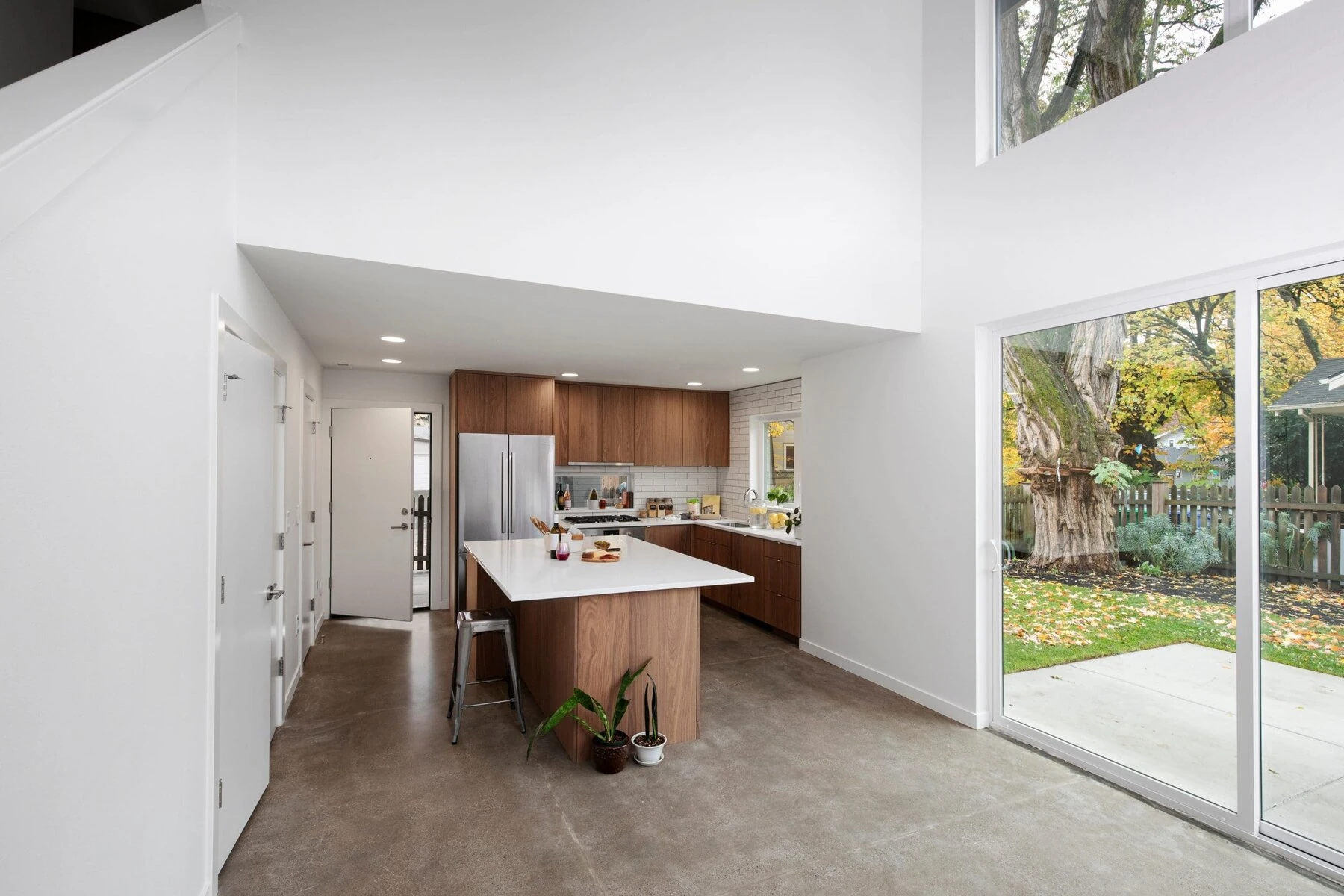
| 9-foot ceilings minimum | Taller walls; avoid dropped soffits | Dramatically changes spatial perception for minimal cost |
| Built-in storage and multifunctional furniture | Murphy beds, bench seating with storage, floor-to-ceiling cabinetry | Reduces clutter; increases functional capacity |
| Large windows and glass doors | Maximize south-facing glazing; use transom windows for borrowed light | Natural light is the single strongest predictor of tenant satisfaction |
Overcoming “ADU Anxiety”: A Phase-by-Phase Emotional Roadmap
ADU anxiety is real. Research and homeowner surveys consistently identify five emotional stress points during the ADU journey. Here is a systematic approach to managing each.
Phase 1 — Pre-Decision Paralysis
The anxiety: “Can I even build one? What if I spend money on plans and the city says no?”
The fix: Commission a paid feasibility study from a local ADU specialist before spending on full architectural plans. A 500–1,000 dollar feasibility study should answer: allowed size, setbacks, utility connection feasibility, and an estimate of total soft and hard costs. This small upfront investment eliminates the biggest unknown.
Phase 2 — Permit and Approval Anxiety
The anxiety: “The city will reject my plans. This will take forever.”
The fix: Understand that by-right states require objective standards. If your project meets the published criteria, approval is mandatory. In faster jurisdictions like Los Angeles and Long Beach, plan check can be as short as 3–4 months; in slower cities, 12-plus months is not unusual. Work with a design professional who has successfully permitted ADUs in your specific city. Pre-approved or “catalog” ADU plans can accelerate this phase significantly in some jurisdictions.
Phase 3 — Financing Fear
The anxiety: “I’ll never qualify for a loan. This will drain my savings.”
The fix: The ADU financing ecosystem is far broader than most homeowners realize. If you have home equity, a HELOC or cash-out refinance is straightforward. If you do not have equity, ADU-specific unsecured construction loans are available (at higher rates). California homeowners should check CalHFA grant cycles, which open twice yearly. The single best step is to get pre-qualified for multiple financing products before finalizing your design.
Phase 4 — Construction Chaos
The anxiety: “Costs are spiraling. My contractor is unreachable. This will never finish.”
The fix: Proper contractor vetting prevents most construction horror stories. The most reliable predictor of a successful build is not the lowest bid but the contractor’s specific ADU experience. Ask for addresses of three completed ADUs you can drive by. Check license status, workers compensation insurance, and whether they carry builder’s risk insurance.
The Bid Comparison Framework
| What to Compare | Red Flags |
|---|---|
| Line-item detail | “Allowance” items without specified dollar amounts |
| Exclusions (what is NOT included) | Vague language like “as needed” |
| Payment schedule | Large upfront deposits (more than 10%); final payment before certificate of occupancy |
| Change-order policy | No written change-order process described |
| Timeline with milestones | No specific dates; “flexible” schedule |
Always include a contingency line in your budget of 10–20% of total project cost, reserved for unforeseen conditions (soil issues, utility conflicts, material price spikes).
Phase 5 — Landlord Anxiety
The anxiety: “What if I get a bad tenant? What if something breaks and I cannot afford to fix it?”
The fix: Professional tenant screening is the single best defense. Use a service that verifies income (requiring gross monthly income of at least 3x rent), checks credit, and contacts previous landlords. Set aside a maintenance reserve of 10–15% of monthly rent. And strongly consider forming an LLC to hold the rental property, which separates your personal assets from the rental business.
Checklist: Is Your Property ADU-Ready?
Pre-Feasibility Self-Assessment
| Criterion | Yes | No | Action If No |
|---|---|---|---|
| Lot zoned for single-family or multifamily residential? | Check local zoning map; in many states, ADUs are now permitted in all residential zones | ||
| Sufficient setback space for proposed ADU type? | Detached ADUs in California typically require 4-foot side and rear setbacks; verify local rules | ||
| Utility capacity available (water, sewer, electric)? | Request a “will-serve” letter from utility providers; budget for upgrades if needed | ||
| No HOA prohibition (or state law overrides)? | Review CC&Rs; confirm whether state law invalidates restrictions | ||
| Access for construction equipment? | Narrow lots or limited street access may increase costs | ||
| Parking solution? | Many jurisdictions waive parking for ADUs near transit; confirm local policy |
Frequently Asked Questions
How long does the entire ADU process take, from idea to rental income?
In an ADU-friendly jurisdiction with a well-organized owner, plan for 10–14 months total: 2 months for design and engineering, 4 months for permitting, and 6–8 months for construction. In slower jurisdictions, add 6–12 months to the permitting phase.
Can I build an ADU if I still have a mortgage?
Yes. Your existing lender cannot block an ADU permit application. However, if you plan to finance the ADU with a cash-out refinance or HELOC, your current lender will be involved. If using separate ADU-specific financing, your existing mortgage remains untouched.
Do I have to live on the property to rent the ADU?
It depends on your state and city. California eliminated the statewide owner-occupancy requirement entirely. Washington and Oregon have largely removed it. Other states vary—check local rules.
Will an ADU increase my property taxes?
Yes, but generally only on the added value of the new construction, not the entire property. Expect an annual increase of approximately 1.0–1.25% of the ADU construction cost, depending on your local tax rate.
Can I use my ADU as a short-term rental (Airbnb or VRBO)?
Potentially, but this is heavily regulated at the city level. Many cities that encourage ADU construction explicitly prohibit short-term rentals of less than 30 days for ADUs. Check your city’s short-term rental ordinance before building if this is part of your strategy.
What is the difference between a JADU and a full ADU?
A Junior ADU is a smaller unit (maximum 500 square feet in California) created entirely within the existing walls of a single-family home, often with shared bathroom facilities. JADUs have a streamlined permitting process but lower rental value. A full ADU is a complete independent living unit with its own kitchen, bathroom, and entrance.
What if my city has not adopted the latest state ADU laws?
In some states, if a city fails to adopt compliant ADU ordinances within statutory deadlines, the state law provisions apply directly. In California, for example, non-compliant ordinances can be invalidated, and the state’s minimum standards govern by default. Consult a local land-use professional for your specific situation.
Your ADU Action Plan: Week-by-Week
Month 1 — Foundation
Week 1–2: Check your property’s zoning, review CC&Rs, and pull your title report.
Week 3–4: Commission a paid feasibility study from a local ADU specialist or design-build firm. Simultaneously, apply for pre-qualification with at least two ADU financing sources.
Month 2–3 — Design and Approvals
Week 5–8: Engage an architect or design-build firm with demonstrable local ADU experience. Finalize floor plans, elevation drawings, and preliminary engineering.
Week 9–12: Submit plans to the city. Track the completeness determination deadline (15 business days in California under SB 543). Respond to any plan check comments within one week to keep your project moving.
Month 4–7 — Build (Timing Variable by City)
Permit Issuance: Once permits are issued, finalize your contractor contract with a detailed scope of work, payment schedule, and change-order process.
Construction: Schedule weekly site meetings with your contractor. Keep a written log of all decisions and change orders. Do not make final payment until the certificate of occupancy is in hand.
Month 8–10 — Launch
Pre-Rental: Obtain landlord insurance. Set up your LLC if using one. Photograph the completed unit professionally.
Tenant Placement: List the unit, screen applicants, and sign a written lease agreement. Collect first month’s rent and security deposit before handing over keys.
Building an ADU is one of the most impactful financial decisions a homeowner can make. The difference between a stressful money pit and a profitable asset is almost always preparation: understanding the legal framework, locking in the right financing, designing for the target rental market, and hiring experienced professionals who have done this exact thing before. The homeowners who treat their ADU as a business from day one are the ones who end up with positive monthly cash flow and a property worth substantially more than they invested.
Sources cited in this guide include EffectiveAgents ADU regulatory database, the Mercatus Center 2025 state ADU taxonomy, Greenberg Construction verified rental analyses, the California Legislative Information database for SB 543, AB 462, SB 1077, and SB 9 of 2025, SageRE Group project cost data, the Rocket Lawyer landlord legal guide, and multiple ADU construction specialists. All financial figures are based on 2025–2026 market data and should be verified for your specific location.