Building a new construction home is a multi-phase journey that typically spans 12 to 24 months from land purchase to move-in. In 2026, expect to invest 300 to 600+ dollars per square foot in competitive markets like San Diego County, with total costs ranging from 500,000 dollars for a modest custom build to well over 2 million dollars for luxury coastal construction. You will navigate seven distinct phases: defining your vision and budget, selecting and purchasing land, assembling a professional team, designing the home, securing permits, managing construction, and completing final inspections before occupancy. The single most important decision you make is choosing between a design-build firm (which handles architecture, engineering, and construction under one contract) and a traditional architect-then-bid approach — this choice directly impacts your timeline, budget, and stress level. This guide walks you through every step with 2026 costs, timelines, and San Diego-specific insights so you can build with confidence.
Table of Contents
What Is a New Construction Home?
A new construction home is a dwelling that has never been previously occupied. Unlike purchasing a resale home, building new gives you complete control over the layout, materials, systems, and finishes. In 2026, new construction also means compliance with the latest California Building Code (2025 California Codes effective January 1, 2026), which mandates higher energy efficiency, water conservation, and fire-resistant standards.
Types of New Construction Homes
| Type | Description | Customization Level | Typical Timeline | Cost Range (San Diego 2026) |
|---|---|---|---|---|
| Custom Home | Built from scratch on your land; you control every detail. | Full | 16–24+ months | 400–800+ per sq ft |
| Semi-Custom Home | Builder offers pre-designed floor plans with modification options. | Moderate | 10–16 months | 300–500 per sq ft |
| Spec Home | Builder constructs without a buyer; limited finish selections available if purchased mid-build. | Limited | 6–10 months (buyer involved late) | 250–450 per sq ft |
| Production/Tract Home | Part of a master-planned community; choose from builder’s catalog. | Minimal to Moderate | 6–9 months | 200–350 per sq ft |
| Accessory Dwelling Unit (ADU) | Secondary unit on an existing residential lot; detached or attached. | Full (custom) or Pre-Approved Plans | 6–14 months | 180–350+ per sq ft |
Custom homes offer unlimited design freedom but require the longest timeline and highest budget due to architectural design, engineering, and fully bespoke material selection. Spec homes provide faster move-in and lower per-square-foot costs because the builder standardizes materials and processes. For many San Diego homeowners, the design-build model combines the best of both worlds: custom design with streamlined execution.
Step 1: Define Your Vision and Set a Realistic Budget
Before you look at a single lot or talk to any builder, you must define what you are building and how much you can spend. This is the phase where mistakes are most expensive to fix later.
Functional Planning: Start With How You Live, Not What It Looks Like
Most homeowners begin with finishes — flooring, countertops, paint colors. The smarter approach is to define function first. Ask yourself these questions:
-
How many bedrooms and bathrooms do you need today, and what will you need in 5 to 10 years?
-
Do you work from home and need dedicated office space, or flexible multi-use rooms?
-
Is single-level living important for aging in place?
-
Do you entertain frequently, and what flow do you need between kitchen, dining, and outdoor spaces?
-
What storage requirements do you have (sports equipment, hobby supplies, seasonal items)?
-
Do you need space for multi-generational living, such as an in-law suite or ADU?
Defining function before form prevents costly mid-construction design changes — the single largest source of budget overruns in custom builds.
Budgeting: Beyond Cost Per Square Foot
A realistic budget includes far more than the cost of lumber and labor. Break your budget into these categories:
| Budget Category | % of Total Budget | Details |
|---|---|---|
| Land Acquisition | 15–25% | Raw lot, utility connections, surveys |
| Site Preparation | 5–10% | Clearing, grading, excavation, soil remediation |
| Hard Construction Costs | 45–55% | Foundation, framing, roofing, drywall, labor |
| Mechanical Systems | 10–15% | Plumbing, electrical, HVAC, fire sprinklers |
| Interior Finishes | 10–20% | Flooring, cabinetry, countertops, trim, paint |
| Permits & Fees | 3–8% | Building permits, impact fees, school fees, utility connection fees |
| Professional Services | 8–15% | Architect, engineer, designer, project management |
| Landscaping & Hardscape | 5–10% | Grading, irrigation, plants, patios, driveways |
| Contingency Reserve | 10–20% | Unforeseen conditions, change orders, material price fluctuations |
2026 San Diego Cost Benchmarks:
-
-
Custom home construction: 400 to 800+ dollars per square foot for hard costs, excluding land.
-
High-end coastal builds (La Jolla, Del Mar, Coronado): 700 to 1,200+ dollars per square foot.
-
Semi-custom in inland communities (La Mesa, Spring Valley): 300 to 500 dollars per square foot.
-
ADU construction (detached, up to 1,200 sq ft): 180,000 to 400,000+ dollars total all-in.
In Southern California markets, hard costs for a custom home routinely start at 450 dollars per square foot and can easily exceed 1,000 dollars per square foot depending on site complexity, soil conditions, and finish level. A 2,000-square-foot custom home in San Diego County typically costs 600,000 dollars or more, excluding land acquisition and site preparation.
-
Financing: Understanding Your Options
Construction financing is fundamentally different from a standard mortgage. You cannot use a conventional 30-year fixed mortgage to fund a ground-up build. Here are your primary options in 2026:
| Financing Type | How It Works | Best For | Down Payment | Key 2026 Consideration |
|---|---|---|---|---|
| Construction-to-Permanent Loan (C2P) | Single closing; interest-only during construction, converts to permanent mortgage. | Most custom home builders | 20–30% | One set of closing costs; rate locked at closing. |
| Construction-Only Loan | Short-term loan for build phase; requires separate permanent mortgage at completion. | Builders who want to shop mortgage rates later | 20–35% | Two closings, risk of rate increases during construction. |
| Owner-Builder Loan | For homeowners acting as their own GC. | Experienced construction professionals only | 25–35% | Difficult to qualify; most lenders require proven experience. |
| FHA Construction-to-Permanent | Government-backed; lower down payment. | First-time builders with limited capital | 3.5% | 2025 loan limits: 524,225standard,524,225standard,1,209,750 high-cost areas. |
| Jumbo Construction Loan | For builds exceeding conforming loan limits. | High-cost markets like San Diego coastal | 20–30% | 2025 baseline conforming limit: 806,500;high−cost:806,500;high−cost:1,209,750. |
| Home Equity Loan / HELOC | Leverage existing home equity to fund new build. | Homeowners with significant equity | N/A | Risk of losing primary residence if project overruns. |
Construction-to-permanent (C2P) loans are the most popular choice for custom home builds in 2026. They combine the construction loan and permanent mortgage into a single closing, reducing fees and locking in your long-term rate. Lenders typically release funds in “draws” tied to construction milestones: foundation, framing, mechanical rough-in, drywall, and final completion.
Pro Tip: Expect to provide a 30% to 35% down payment for most construction loans. Your lender will require detailed architectural plans, a fixed-price or cost-plus contract with your builder, and a construction timeline before approving the loan.
Step 2: Find and Purchase the Right Lot
Your lot dictates nearly everything: the home’s size, orientation, foundation type, and cost of utility connections. A “good deal” on land can become a financial disaster if the site requires extraordinary site work.
Lot Evaluation Checklist
-
Zoning & Land Use: Verify the parcel is zoned for single-family residential. Confirm no overlay restrictions (coastal, historic, environmental).
-
Utility Access: Does the lot have municipal water and sewer connections, or will you need a well and septic system? What is the cost to bring utilities to the build site?
-
Soil Condition & Geotechnical Report: Expansive soils, bedrock, or high water tables dramatically increase foundation costs. Order a soils report before closing.
-
Topography & Drainage: Steep lots in San Diego hillside communities (Mount Helix, La Mesa hills, coastal bluffs) require retaining walls, caisson foundations, and engineered drainage — adding 50,000 to 200,000+ to your budget.
-
Fire Zone & WUI Requirements: Much of San Diego County is in a Wildland-Urban Interface (WUI) zone, requiring fire-resistant construction materials, ember-resistant vents, and defensible space landscaping.
-
HOA & CC&Rs: If the lot is in a planned community, review all covenants, conditions, and restrictions. Some HOAs require specific architectural styles, minimum square footage, or restrict ADUs.
-
School Districts & Future Development: Research planned infrastructure projects, zoning changes, and school district boundaries that may affect property value.
-
Seismic & Environmental Hazards: Check FEMA flood maps, earthquake fault zones, and California Natural Hazards Disclosure reports.
If you are building in San Diego County unincorporated areas, the county Building Services Division issues permits and enforces specific grading, septic, and well regulations that differ from city jurisdictions.
Step 3: Assemble Your Professional Team
Building a custom home requires a coordinated team of professionals. The average custom home involves 22 different subcontractors before completion. You have two fundamental delivery models to choose from:
Design-Build vs. Traditional (Design-Bid-Build)
| Factor | Design-Build (Single Contract) | Traditional (Architect + Separate GC) |
|---|---|---|
| Contract Structure | One firm provides design and construction under one contract. | Separate contracts with architect/designer and general contractor. |
| Timeline | Faster — design and pre-construction overlap; construction can begin 2–3 months after design approval. | Slower — design completed, then put out to bid, then contractor mobilized. |
| Cost Certainty | High — builder provides pricing during design, reducing budget surprises. | Moderate — true costs unknown until bids received; can exceed architect estimates. |
| Accountability | Single point of responsibility; no finger-pointing between designer and builder. | Homeowner mediates between architect and contractor if issues arise. |
| Best For | Homeowners who want streamlined process, single-source accountability, and faster delivery. | Homeowners who want a bespoke architectural statement piece and are willing to manage complexity. |
Design-build can be faster because the same team progresses design decisions and construction planning simultaneously. For straightforward to moderately complex projects, this route is more efficient with fewer consultants to coordinate. In the traditional model, the homeowner often gets caught between the architect and contractor when problems surface.
Key Team Members
-
General Contractor (GC) or Design-Build Firm: The central hub responsible for day-to-day site management, subcontractor coordination, scheduling, and quality control.
-
Architect or Residential Designer: Creates floor plans, elevations, and design documents. In a design-build firm, this role is in-house.
-
Structural Engineer: Calculates loads, designs foundation, framing, and lateral (seismic/wind) systems. Essential for hillside and coastal San Diego sites.
-
Civil Engineer: Handles grading, drainage, retaining walls, and utility design.
-
Geotechnical Engineer: Evaluates soil conditions and provides foundation recommendations.
-
Interior Designer: Assists with finish selections, lighting design, cabinetry, and material coordination.
-
Land Surveyor: Establishes property boundaries, topography, and site constraints.
When vetting builders in San Diego County, verify California State License Board (CSLB) standing, check references from completed projects in your specific municipality, and visit active job sites to observe site cleanliness, organization, and safety practices.
Step 4: Design Your Home and Secure Permits
The Design Phase: 1 to 6+ Months
The design phase progresses through three stages:
-
Schematic Design (1–2 months): Bubble diagrams, rough floor plans, exterior concept, and preliminary budget.
-
Design Development (1–3 months): Refined floor plans, elevations, structural concept, material palette, and detailed cost estimate.
-
Construction Documents (1–3 months): Permit-ready drawings including architectural, structural, mechanical, electrical, plumbing, and energy compliance (Title 24) sheets.
In San Diego, the design and permitting phase for a custom home commonly takes 12 to 18 months due to the number of agencies involved: planning, building, fire, public works, and sometimes coastal commission.
Permitting: What You Need and What It Costs
Your builder or architect typically handles permit procurement. You will need permits for:
-
Building (structural)
-
Electrical
-
Plumbing
-
Mechanical (HVAC)
-
Grading (if moving soil)
-
Sewer/Septic or Water/Sewer connections
-
Fire sprinklers (required for all new California single-family homes since 2011)
-
Solar photovoltaic (mandated by California Title 24 for new construction)
-
Encroachment (if work extends into public right-of-way)
Permit costs in San Diego County typically range from 2,500 to 15,000+ depending on project size and jurisdiction. Plan on 3 to 6 months for permit review and approval, though complex coastal or hillside projects may take longer. Impact fees, school fees, and utility connection charges can add 20,000 to 60,000+ to your total.
Step 5: The Construction Phase — A Detailed Timeline
Once permits are issued and financing is in place, construction begins. Here is a realistic phase-by-phase timeline for a 2,500-square-foot custom home in San Diego County in 2026.
| Construction Phase | Duration | Key Activities | Inspections |
|---|---|---|---|
| Site Preparation & Grading | 2–6 weeks | Clearing, demolition, rough grading, erosion control, temporary utilities. | Grading, erosion control |
| Foundation | 3–6 weeks | Trenches, rebar, formwork, concrete pour, waterproofing, foundation drainage. | Soils compaction, rebar, foundation pre-pour |
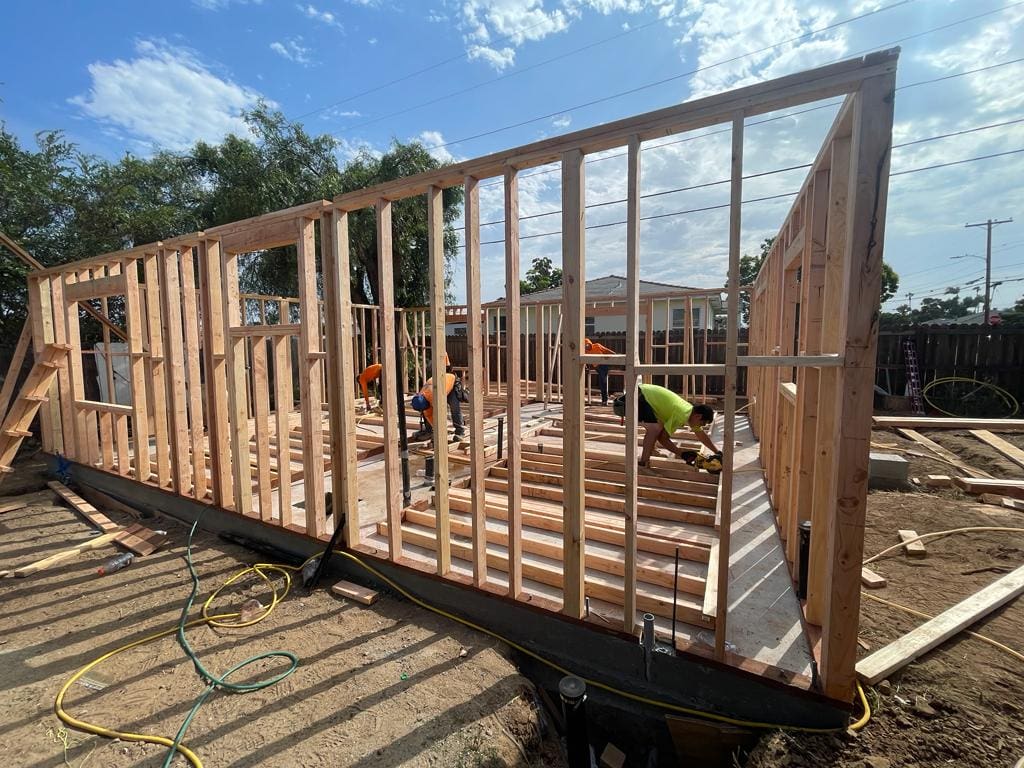
| Framing & Roofing | 4–8 weeks | Wall framing, floor joists, roof trusses, sheathing, roofing underlayment. | Framing, hold-downs, shear wall nailing |
| Windows & Exterior Doors | 1–2 weeks | Installation, flashing, weather-resistive barrier. | Window flashing, WRB |
| Rough Mechanicals (MEP) | 4–8 weeks | Plumbing rough-in, electrical rough-in, HVAC ductwork, fire sprinklers. | Plumbing, electrical, mechanical rough-in |
| Insulation & Drywall | 2–4 weeks | Insulation (batts, blown, or spray foam), drywall hanging, taping, texturing. | Insulation, lath (if applicable) |
| Interior Finishes | 6–12 weeks | Cabinetry, countertops, flooring, tile, trim, doors, painting, fixtures. | Various |
| Final MEP Trim-Out | 2–4 weeks | Light fixtures, outlets/switches, plumbing fixtures, HVAC registers, appliance install. | Final electrical, plumbing, mechanical |
| Site Work & Hardscape | 2–6 weeks | Driveways, walkways, patios, retaining walls, fencing, irrigation. | Final grading |
| Final Inspection & Certificate of Occupancy | 1–3 weeks | Building inspector final review, fire marshal sign-off, C of O issuance. | Final building |
Total construction duration: 8 to 16 months for a custom home, though timeline compression is possible with a design-build approach and experienced project management. On average, single-family home construction takes 6.5 to 7.2 months nationally once permits are issued, but custom homes with complex site conditions extend well beyond.
Step 6: Inspections, Walkthrough, and Move-In
Critical Inspections
Do not skip any inspection. Key inspection points include:
-
Pre-Pour Foundation Inspection: Confirms rebar, formwork, and embedments are correct before concrete is placed.
-
Framing and Shear Wall Inspection: Verifies structural integrity, hold-downs, and nailing patterns — critical in seismic San Diego.
-
Rough-In Inspections (Plumbing, Electrical, Mechanical): Must be completed before insulation and drywall cover the work.
-
Insulation Inspection: Confirms proper R-values and installation quality.
-
Final Inspection: Comprehensive review of all systems, safety features, and code compliance before Certificate of Occupancy is issued.
Schedule a pre-drywall walkthrough with your builder. This is your one opportunity to see the bones of your home — framing, plumbing, electrical, HVAC — before they are covered. Document everything with photos for future reference.
Final Walkthrough and Punch List
Conduct a thorough final walkthrough with your builder using a detailed checklist. Inspect every surface, test every outlet, run every faucet, and check every door and window for proper operation. Common items on a punch list include:
-
Drywall imperfections (nail pops, visible seams, texture inconsistencies)
-
Paint touch-ups on walls, trim, and ceilings
-
Flooring transitions, tile grout uniformity, and caulk bead integrity
-
Cabinet door alignment, drawer slide function, and hardware fit
-
Plumbing fixture leaks, low water pressure, and proper hot water delivery
-
HVAC system balancing, thermostat function, and filter access
-
Exterior grading, drainage, and landscaping completeness
Step 7: Post-Construction — Warranties, Insurance, and Maintenance
Warranties
New construction homes come with several layers of warranty protection. Understand what your builder provides:
| Warranty Type | Typical Duration | What It Covers |
|---|---|---|
| Workmanship Warranty | 1 year | Defects in materials and workmanship: drywall cracks, paint issues, flooring problems, fixture failures. |
| Systems Warranty | 2 years | Electrical, plumbing, HVAC, and mechanical systems. |
| Structural Warranty | 10 years | Foundation, load-bearing walls, beams, columns, and roof structure. |
| Manufacturer Warranties | Varies | Appliances, roofing materials, windows, water heaters, HVAC equipment. |
In California, builders are required to provide a 1-year fit and finish warranty, a 2-year systems warranty, and a 10-year structural defect warranty for new residential construction under the Right to Repair Act (SB 800). Always obtain written warranty documentation before closing.
Homeowners Insurance for New Construction
Your builder carries builder’s risk insurance during construction — this protects the builder’s investment, not yours. Before closing, you must secure a homeowners insurance policy. Key considerations:
-
Builder’s risk insurance does not cover your personal property or liability during construction.
-
New construction homes typically qualify for lower insurance premiums than older homes due to modern building codes, updated electrical/plumbing, and impact-resistant roofing.
-
Inform your insurance agent that the home is new construction with fire sprinklers, hardwired smoke/CO detectors, and wind-resistant features — all of which may qualify for premium discounts.
-
Ensure the policy’s dwelling coverage reflects the full rebuild cost (replacement cost), which may differ from the market value or construction cost.
Modern Construction Innovations in 2026
Energy Efficiency and Net-Zero Construction
In 2026, California Title 24 energy standards require new homes to be equipped with solar photovoltaic systems, high-efficiency HVAC, and enhanced building envelope performance. Many homeowners are going beyond code minimum to achieve:
-
Net-Zero Energy: Homes that produce as much energy as they consume annually, achieved through solar PV, battery storage, heat pump HVAC, and high-performance envelopes.
-
Energy Star Certification: Verified homes that are at least 10% more efficient than code.
-
Zero Energy Ready Home (ZERH): Department of Energy certification ensuring the home is so efficient that a renewable energy system can offset all annual energy consumption.
-
Passive House (Passivhaus): Ultra-low energy buildings with rigorous standards for airtightness (0.6 ACH50 or lower), thermal bridge-free design, and heat recovery ventilation.
Air sealing is the most cost-effective energy upgrade. A home achieving 0.4 ACH50 (air changes per hour at 50 pascals) compared to a typical 3.0 ACH50 can reduce energy use by 50% or more while improving comfort and indoor air quality.
Smart Home Integration
Integrating smart home infrastructure during construction — when walls are open — costs a fraction of what retrofitting requires. Key 2026 smart home systems to pre-wire:
-
Structured Wiring Panel: Central hub for ethernet (Cat 6A or fiber), coaxial, and low-voltage distribution to every room.
-
Whole-Home Wi-Fi: Ceiling-mounted access points for seamless coverage.
-
Smart Lighting & Automated Shades: Pre-wire for centralized lighting control systems.
-
Security & Surveillance: PoE (Power over Ethernet) camera wiring, door/window sensors, and motion detectors.
-
Smart HVAC Zoning: Motorized dampers and smart thermostats for room-by-room climate control.
-
EV Charging Infrastructure: 240V dedicated circuits in the garage; conduit for future expansion.
-
Battery Storage Ready: Electrical panel design to accommodate home battery systems (e.g., Tesla Powerwall, Enphase) for energy independence and outage resilience.
-
Smart Leak Detection: Whole-home water monitoring with automatic shut-off valves.
Sustainable Building Materials
Sustainable materials reduce embodied carbon and improve indoor air quality. Commonly specified in 2026 custom builds:
-
Engineered lumber: Laminated veneer lumber (LVL), I-joists, and cross-laminated timber (CLT) reduce old-growth timber consumption.
-
Insulated concrete forms (ICFs): Interlocking foam blocks filled with concrete provide continuous insulation and thermal mass.
-
Recycled-content materials: Low-carbon concrete, recycled glass countertops, and composite decking.
-
Low-VOC and Zero-VOC products: Paints, adhesives, sealants, and flooring that reduce off-gassing and improve indoor air quality.
-
Hempcrete and bio-based insulation: Emerging options for carbon-negative building assemblies.
Common Mistakes to Avoid When Building a New Home
-
Skipping the Geotechnical Report: Building without a soils report is gambling. Expansive soils, undocumented fill, or shallow groundwater can require foundation redesigns costing tens of thousands.
-
Changing Design After Construction Starts: The most expensive change order is one made after framing or rough-in is complete. Finalize every detail during design — moving a wall during framing is relatively easy; moving it after drywall and electrical rough-in is not.
-
Underestimating Site Work Costs: Driveway grading, retaining walls, utility trenching, and drainage systems can easily cost 50,000 to 150,000+ on challenging lots.
-
Budgeting Without a Meaningful Contingency: Allocate 15% to 20% of your total budget for unforeseen conditions — not 5%. Material price volatility, weather delays, and hidden site conditions are real and frequent.
-
Selecting a Builder Based on Lowest Bid Alone: Low bids often exclude scope that higher bids include, or assume lower-grade materials. Compare bids line-by-line, not by bottom line.
-
Neglecting Drainage and Grading: Poor drainage is the leading cause of foundation problems, mold, and water intrusion. Ensure the finished grade slopes away from the house in all directions.
-
Forgetting About the Sun and Site Orientation: Passive solar design — proper window placement, overhang sizing, and thermal mass — can reduce heating and cooling costs by 20% to 40% with no additional construction cost.
-
Under-Building Storage and Utility Spaces: Mechanical rooms, electrical panels, water heaters, air handlers, and storage rooms need more space than you think. Plan for accessible, code-compliant clearances.
-
Not Planning for Future Needs: Pre-wire for EV chargers, solar battery storage, and future room expansions. Rough-in plumbing for a future ADU or basement bathroom. These future-proofing measures are exponentially cheaper during initial construction.
-
Overlooking Insurance During Construction: Builder’s risk insurance protects the builder’s investment, not yours. Confirm you have appropriate coverage for your interest and verify that your builder’s insurance is current and adequate.
San Diego-Specific Considerations for 2026
Local Building Codes and Regulations
San Diego County enforces the 2025 California Building Codes effective January 1, 2026. Key local requirements:
-
Fire Hardening (WUI Zones): Class A roof coverings, ember-resistant vents, multi-pane tempered windows, and non-combustible decking in designated Wildland-Urban Interface areas.
-
Seismic Design: All new structures must comply with California Building Code Chapter 16 structural design requirements, including specific seismic detailing for shear walls, hold-downs, and foundation anchors.
-
Title 24 Energy Compliance: Mandatory solar PV system sizing based on climate zone and conditioned floor area; high-efficacy lighting; and cool roof requirements.
-
Water Conservation: WaterSense-labeled fixtures, high-efficiency irrigation controllers, and drought-tolerant landscaping.
-
ADU Regulations (Updated August 2025): Detached ADUs up to 1,200 square feet are permitted on most single-family lots; impact fees are waived for units under 750 square feet; and parking requirements are eliminated for properties within half a mile of transit stops.
San Diego Permitting Realities
-
City of San Diego: Plan review times vary by project complexity; expect 6 to 12+ weeks for initial review.
-
Coastal Zone: Properties within the Coastal Overlay Zone require Coastal Development Permits in addition to building permits. This adds 3 to 12+ months to the permitting timeline.
-
Unincorporated County: The County Building Division issues permits for areas outside city limits (e.g., Spring Valley, parts of La Mesa, rural East County). Separate grading permits and well/septic approvals may be required.
Local Construction Cost Drivers
-
Labor Shortages: Skilled construction labor is in high demand across Southern California, driving up costs and extending schedules.
-
Coastal Engineering: Homes on coastal bluffs or within the Coastal Zone often require specialized foundation systems (caissons, tie-backs), corrosion-resistant materials, and coastal commission review.
-
Fire Zone Requirements: Building in WUI zones adds 15,000 to 50,000+ for fire-resistant siding, decking, vents, and windows.
-
Hillside Construction: Steep slope construction involves retaining walls, underpinning, and extensive grading, adding 50,000 to 200,000+ to project costs.
Frequently Asked Questions
How long does it take to build a new construction home?
From land purchase to move-in, expect 12 to 24 months for a custom home in San Diego County. Design and permitting alone can take 6 to 12+ months; construction typically takes 8 to 16 months depending on size, complexity, and site conditions. Production and semi-custom homes can be completed in 6 to 12 months once permits are issued.
What is the cost per square foot to build in San Diego?
In 2026, expect to pay 300 to 500 per square foot for standard custom construction, 400 to 800+ per square foot for mid-to-high-end finishes, and 700 to 1,200+ per square foot for luxury coastal builds. These figures are for hard construction costs only and exclude land, permits, and soft costs.
Is $400,000 enough to build a house in San Diego?
A budget of 400,000 dollars is generally not sufficient for a full single-family custom home in San Diego County. At 300 to 500 dollars per square foot, a 2,000-square-foot home costs 600,000 dollars or more. However, 400,000 dollars may cover a smaller, efficient design or a detached ADU.
What is better: design-build or traditional construction?
Design-build is typically faster and more cost-certain because one firm handles both design and construction under a single contract. It reduces the risk of disputes between architect and contractor and eliminates the homeowner’s role as intermediary. Traditional (design-bid-build) may be preferred for highly complex architectural projects where the homeowner wants a pure design vision developed before a builder is engaged. For most custom homes in San Diego, the design-build model offers greater efficiency and accountability.
Do I need an architect or can I use a designer?
For custom homes, a licensed architect or a residential designer working under the supervision of a licensed engineer is strongly recommended. In California, single-family homes of wood frame construction not exceeding two stories and a basement may be designed by an unlicensed designer if structural engineering is provided by a licensed engineer. However, an architect brings value in spatial design, natural light optimization, and material selection that often exceeds their fee.
What happens if my project goes over budget?
Budget overruns are common and usually stem from one of four sources: (1) change orders initiated by the homeowner after construction begins, (2) unforeseen site conditions (rock, water, poor soil), (3) material price escalation, or (4) scope creep. Protect yourself with a 15–20% contingency fund, a detailed contract that defines how change orders are priced, and a builder who provides transparent, real-time cost tracking.
Build Your Custom Home With Golden Shore Design & Build
Building a new construction home is one of the most significant investments you will ever make. Choosing the right partner determines whether the experience is rewarding or exhausting. At Golden Shore Design & Build, we bring every critical discipline under one roof: architectural design, 3D renderings, structural engineering, interior design, permit coordination, and construction — all managed by a dedicated project manager who provides transparent, real-time communication from concept to completion.
We are a top-rated, licensed, bonded, and insured general contractor serving all of San Diego County, including coastal communities (La Jolla, Del Mar, Encinitas, Carlsbad) and inland areas (Chula Vista, National City, La Mesa, Spring Valley). Our design-build approach eliminates the finger-pointing between architect and contractor, reduces timeline by overlapping design and pre-construction, and provides cost certainty through early builder involvement.
Every Golden Shore project includes:
-
In-house architectural design and 3D visualization so you see your home before we break ground.
-
Comprehensive permit coordination — we navigate San Diego’s complex regulatory landscape.
-
Transparent, fixed-price or cost-plus pricing with no hidden fees.
-
On-site project management with weekly progress updates and budget tracking.
-
Satisfaction guarantee backed by our track record of on-time, on-budget delivery.
-
Deep expertise in California ADU regulations — we make building an ADU straightforward and cost-effective.
Your dream home is not a line item on a spreadsheet; it is where your life will unfold for decades. Let’s build it right.
Book your free design consultation today.
Related Articles
Why You Should Consider Phasing Your Renovation
Three Crucial Steps Before Building New In San Diego
The “Before You Demo” Checklist Every Homeowner Needs
The Complete Home Renovation Roadmap: A Step‑by‑Step Guide From First Sketch to Final Walkthrough
San Diego ADU Construction: Fast-Track Your Build & Avoid Costly Mistakes
San Diego Permit Process Guide for Homeowners (2026): Step-by-Step, Fees, Timelines, and Updates
People Also Ask
The typical process of building a home involves five key stages. First is site preparation and foundation work, which includes clearing the land, excavating, and pouring the concrete slab or basement. Second is rough framing, where the structural skeleton, roof, and exterior walls are erected. Third is rough-in work, covering the installation of plumbing, electrical wiring, and HVAC systems. Fourth is interior and exterior finishes, such as drywall, flooring, painting, cabinetry, and siding. Finally, the fifth stage is final walkthrough and landscaping, which includes installing fixtures, completing driveways, and planting. For a detailed breakdown of these phases, please refer to our internal article titled Services. At Golden Shore Design and Build, we guide clients through each step to ensure quality and compliance with local codes in San Diego.
A budget of $400,000 can be sufficient to build a house, but the final cost depends heavily on the size, design, and materials you choose. In the San Diego area, including Chula Vista, National City, La Mesa, and Spring Valley CA, construction costs typically range from $150 to $300 per square foot. This means a $400,000 budget might cover a home of roughly 1,300 to 2,600 square feet, assuming a standard finish level. However, factors like land preparation, permits, utility connections, and unexpected site conditions can impact the total. For a more accurate estimate, it is wise to work with a professional team. Golden Shore Design and Build can help you evaluate your specific lot and design goals to ensure your budget aligns with realistic construction costs and local building standards.
The correct order to build a house typically follows a structured sequence. It begins with site preparation and foundation work, including excavation and pouring concrete. Next comes framing, which establishes the walls, roof, and floor structure. After that, rough-in work for plumbing, electrical, and HVAC systems is installed. Insulation and drywall follow, then interior and exterior finishes like flooring, cabinets, and siding. For homeowners in San Diego, Chula Vista, National City, La Mesa and Spring Valley CA, understanding this sequence is crucial to avoid costly delays. For a streamlined process, our internal article San Diego ADU Construction: Fast-Track Your Build & Avoid Costly Mistakes provides expert guidance on fast-tracking your build and avoiding common mistakes. Golden Shore Design and Build recommends always consulting with a licensed contractor to ensure compliance with local codes.
For a budget of $200,000, the size of a house you can build depends heavily on location, materials, and labor costs. In the San Diego area, including Chula Vista, National City, La Mesa, and Spring Valley, construction typically costs between $200 and $350 per square foot for standard finishes. This means you could realistically build a home of approximately 570 to 1,000 square feet, which is often a small one-bedroom or studio unit. However, this figure usually excludes land acquisition, permits, and site preparation, which can add significant expense. A more common approach is to focus on a high-quality, compact design that maximizes efficiency. Golden Shore Design and Build can help you evaluate your specific lot and budget to determine the most viable square footage for your project.
Building a house from the ground up is a significant financial undertaking, with costs varying widely based on design, materials, and location. In the San Diego area, including Chula Vista and National City, the average price typically ranges from $150 to $250 per square foot for standard construction. This estimate covers foundation, framing, roofing, and basic interior finishes. However, custom features, high-end materials, or complex architectural designs can push costs higher. Before starting your project, it is wise to review our internal article titled Three Crucial Steps Before Building New In San Diego. This resource outlines key planning steps to help you budget effectively and avoid common pitfalls. Golden Shore Design and Build recommends securing detailed quotes from multiple contractors and factoring in permits, site preparation, and utility connections to create a realistic financial plan for your new home.