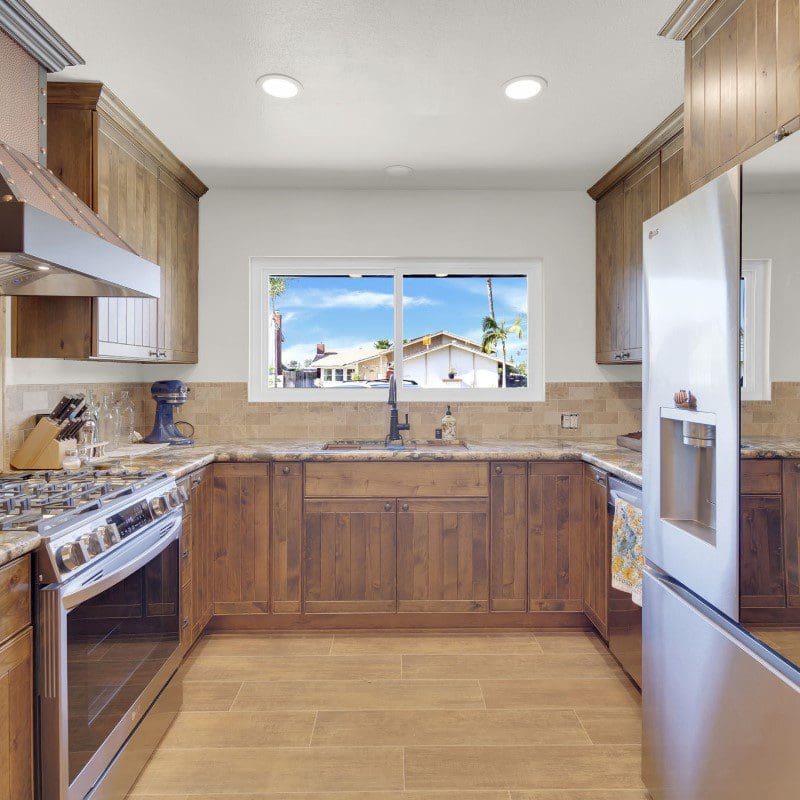
We’ve all walked into an ADU that felt like a glorified closet with a hot plate. The kitchenette is usually the culprit. It’s too small, poorly laid out, or just screams “temporary.” But here’s the thing—when done right, a 60-square-foot kitchenette can function better than a full kitchen in a house twice its size. We’ve built enough of these in San Diego to know exactly where most people go wrong and how to fix it.
Key Takeaways
- A successful ADU kitchenette prioritizes workflow over square footage.
- Smart appliance selection and vertical storage solve the “cramped” feeling.
- Local San Diego regulations (like the 2023 state laws on ADUs) allow for full kitchens in some units, but a kitchenette can still be the smarter choice for accessory units.
- The biggest mistake? Treating it like a mini kitchen instead of a dedicated cooking space.
Table of Contents
The Real Reason Most ADU Kitchenettes Fail
It’s not the size. It’s the layout. We’ve seen homeowners spend $15,000 on beautiful cabinetry only to realize they can’t open the refrigerator door without bumping into the stove. That’s not a design flaw—it’s a failure to think about how people actually move in a small space.
The standard approach is to cram a sink, stove, and fridge along one wall. That works in a galley kitchen that’s 10 feet long. In an ADU where you might have only 6 feet of linear wall space, it creates a dead zone. You end up with no counter space for prep, no landing zone for hot pans, and a trash can that lives in the living room.
We’ve learned the hard way that you have to break the “one wall” rule. Instead, think in zones. A prep zone, a cooking zone, and a cleaning zone. They don’t have to be in a straight line. In fact, an L-shaped layout or even a small island on casters can double your usable space without making the room feel tighter.
What Actually Makes a Kitchenette Feel Full-Size
Vertical Storage Is Non-Negotiable
In a full kitchen, you have lower cabinets, upper cabinets, and probably a pantry. In a kitchenette, you might have half of that. The solution isn’t more cabinets—it’s smarter use of wall space.
We install magnetic knife strips, pegboards for pots, and open shelving for everyday dishes. Not only does this free up cabinet space for dry goods and small appliances, but it also makes the room feel taller and more open. There’s a psychological trick here: when your eye moves up, the space feels larger.
One client in Pacific Beach had a 40-square-foot kitchenette that felt like a broom closet. We removed the upper cabinets entirely, added a floor-to-ceiling pantry cabinet on the end wall, and used open shelving above the sink. She now cooks full meals for two people without breaking a sweat.
Appliance Selection Is Everything
This is where most people either overspend or underspend. You don’t need a 30-inch range. But you also don’t want a two-burner hot plate that takes forever to boil water.
Our go-to setup for a San Diego ADU kitchenette:
- 24-inch induction cooktop (two burners, but they’re powerful)
- 24-inch wall oven (if the unit has the space) or a combination microwave/convection oven
- 18-inch dishwasher (yes, they exist and they work)
- 10- or 11-cubic-foot refrigerator with a freezer drawer
This setup gives you full cooking capability without the footprint. Induction cooktops are particularly good for ADUs because they don’t require a gas line, which can be expensive to run in a garage conversion or a new addition.
For more on the technical requirements for ADUs in California, check the state’s official guidelines at California HCD ADU resources. They’ve updated the rules multiple times in the last few years, and it’s worth knowing what’s allowed before you start buying appliances.
The Counter Space Trade-Off
Here’s a hard truth: you can’t have everything. If you put in a full-size sink, you lose counter space. If you put in a 30-inch cooktop, you lose landing space. Something has to give.
We usually recommend a 24-inch sink with a single basin. It’s deep enough to wash a sheet pan but narrow enough to leave you a solid 18 inches of prep space on either side. That 18 inches is the magic number. It’s enough to chop vegetables, set down a cutting board, or rest a hot pan.
If you’re working with less than 36 inches of total counter space, consider a drop-in cutting board that sits over the sink. It’s not ideal, but it works in a pinch. We’ve also used pull-out counter extensions that slide out from under the countertop. They’re not pretty, but they’re functional.
Lighting Makes or Breaks the Space
Most ADU kitchenettes have terrible lighting. One overhead fixture that casts shadows on the counter. You can’t see what you’re chopping, and the room feels like a cave.
Good lighting is cheap and transformative. Undercabinet LED strips cost about $50 and make the space feel twice as large. Pendant lights over a small island or peninsula add warmth. And for the love of good design, put the switches on a dimmer. Being able to adjust the light level from bright task lighting to soft ambient light makes the room feel like a real kitchen, not a utility closet.
We’ve also started using motion-sensor lights inside cabinets. Open the door, and the light comes on. It’s a small detail, but it’s the kind of thing that makes guests say, “Wow, this is nicer than my kitchen.”
The San Diego Factor
Building an ADU kitchenette in San Diego comes with its own set of quirks. The climate is mild, which means you can often skip the range hood if you have good ventilation and use induction. But the local building department is strict about electrical loads. You can’t just plug in a refrigerator and a microwave on the same circuit.
We’ve had to run dedicated circuits for the refrigerator, the cooktop, and the dishwasher in most of our projects. It adds to the cost, but it’s non-negotiable. A tripped breaker at dinner time is not a good look.
Also, many San Diego ADUs are built in garages or backyards where the existing electrical panel is already maxed out. If you’re planning a kitchenette, factor in a subpanel or a panel upgrade. It’s not sexy, but it’s necessary.
Golden Shore Design & Build has handled dozens of these projects in neighborhoods like North Park, Normal Heights, and Mission Hills. We’ve seen every mistake and found workarounds that actually hold up.
Common Mistakes We See Repeatedly
Mistake 1: Forgetting About Ventilation
You can’t just open a window. In an ADU, especially a garage conversion, you need mechanical ventilation. A recirculating hood (the kind with a charcoal filter) is better than nothing, but it doesn’t remove humidity or smoke. We always spec a ducted hood that vents to the outside, even if it means running ductwork through a soffit.
Mistake 2: Skimping on Counter Material
Solid surface or quartz is worth the extra money in an ADU. Laminate looks cheap and doesn’t hold up to heat or moisture. We’ve seen laminate counters delaminate within a year in a rental unit. Spend the extra $400 and get quartz. It’s durable, heat-resistant, and looks expensive.
Mistake 3: Not Planning for Trash and Recycling
This sounds minor, but it’s a daily frustration. If there’s no dedicated spot for a trash can, it ends up in the living area. We build a pull-out trash bin into the base cabinet next to the sink. It’s a small detail that makes a huge difference in how the space functions.
Mistake 4: Overlooking the Backsplash
A backsplash isn’t just decorative. It protects the wall from grease and water. In a small kitchenette, a full-height backsplash (counter to cabinet) is easy to clean and makes the room feel more finished. We use large-format tiles or a single sheet of quartz to minimize grout lines.
When a Kitchenette Isn’t the Right Choice
Sometimes a full kitchen makes more sense. If the ADU is going to be a long-term rental or a home for an aging parent, a full kitchen with a standard range and a larger refrigerator is better. The kitchenette works best for short-term rentals, guest suites, or units that will be used part-time.
Also, if the ADU is over 500 square feet, most California cities require a full kitchen anyway. Check local zoning before you commit to the kitchenette plan.
We’ve also seen situations where a kitchenette is a bad fit because of the plumbing. If you’re adding a kitchenette to a detached ADU that’s 100 feet from the main house, the cost of running new water and waste lines can be astronomical. In those cases, a wet bar with a sink and a mini fridge might be the smarter move.
The Cost Reality
Here’s a rough breakdown of what a well-done ADU kitchenette costs in San Diego as of 2025:
| Item | Cost Range | Notes |
|---|---|---|
| Cabinetry (custom, plywood boxes) | $3,000 – $5,000 | RTA cabinets save money but look cheap |
| Quartz countertop (20 sq ft) | $1,200 – $1,800 | Includes sink cutout and backsplash |
| 24-inch induction cooktop | $800 – $1,200 | LG or GE are reliable |
| 24-inch wall oven or convection microwave | $1,000 – $1,800 | Combined units save space |
| 18-inch dishwasher | $700 – $1,000 | Bosch or Miele are quiet |
| 11-cu-ft refrigerator | $800 – $1,200 | Samsung or Frigidaire |
| Plumbing and electrical rough-in | $2,500 – $4,000 | Varies wildly by location |
| Ventilation (ducted) | $500 – $1,000 | Includes ductwork |
| Lighting and fixtures | $300 – $600 | Undercabinet lights, pendants, dimmers |
| Total | $10,800 – $17,600 | Excludes labor if DIY |
These numbers are for a mid-range finish. You can go higher with custom cabinets and premium appliances, or lower if you’re willing to compromise on quality. But we’ve learned that cutting corners on the cooktop or the countertop always leads to regret.
The Final Test
Before you finalize the design, do the toast test. Stand in the kitchenette and pretend to make toast. You need a spot for the toaster, a place to put the plate, and access to an outlet. If you can do that without moving your feet, the layout works. If you have to shuffle or reach across the cooktop, it’s wrong.
We’ve used this test on every ADU kitchenette we’ve built at Golden Shore Design & Build located in San Diego, CA. It sounds silly, but it catches layout problems that blueprints miss.
A Smarter Approach to Small Spaces
The best ADU kitchenettes we’ve built aren’t the ones with the most expensive appliances. They’re the ones where every inch has a purpose. Where the trash pull-out is exactly where you need it. Where the lighting makes the space feel warm and functional. Where the cooktop and sink are close enough to be efficient but far enough apart to avoid splashing.
If you’re planning an ADU, don’t let the small square footage discourage you. A kitchenette can be just as functional as a full kitchen—sometimes more so—if you design it with real cooking in mind. Forget the showroom look. Focus on how it will actually be used.
And if you’re in San Diego, don’t ignore the local regulations. They’re not there to make your life harder. They exist because enough people built bad ADUs that the city had to step in. Learn from their mistakes.
When to Call a Pro
This is one of those projects where DIY can save you money on the surface but cost you in the long run. Running electrical for an induction cooktop, venting a hood through a flat roof, and getting the plumbing slope right in a slab-on-grade foundation are not beginner tasks. We’ve seen too many homeowners spend $8,000 on a kitchenette that fails inspection because the electrical was undersized or the vent termination was too close to a window.
If you’re comfortable with basic carpentry and finish work, you can handle the cabinets and countertops. But leave the rough-in work to someone licensed. It’s not worth the risk of a fire or a flood.
At the end of the day, an ADU kitchenette is a compromise. But it’s a compromise that can work beautifully if you respect the constraints and design for reality, not for a magazine cover.
Related Articles
The “Before You Demo” Checklist Every Homeowner Needs
All You Need to Know When Building Accessory Dwelling Units
ADUs As A Modern Solution For Multi-Generational Living
Room Addition / ADU (JADU) Construction in Ramona
San Diego ADU Construction: Fast-Track Your Build & Avoid Costly Mistakes
People Also Ask
To make a small apartment kitchen feel bigger, focus on maximizing light and minimizing clutter. Use light, neutral colors for cabinets and walls to reflect natural light. Install under-cabinet lighting to brighten countertops. Opt for open shelving instead of upper cabinets to create visual space. Choose multi-functional furniture, like a rolling island that doubles as storage. Mirrored backsplashes can also trick the eye into seeing more depth. For tailored advice on layout, Golden Shore Design and Build recommends reading our internal article Is Your Kitchen Layout Working Against You? Here's The Fix, which offers practical solutions for tight spaces.
The most expensive part of building an Accessory Dwelling Unit (ADU) is typically the foundation and site work. This includes excavation, concrete pouring, and utility connections like sewer, water, and electricity. These costs are high because they require heavy machinery, skilled labor, and often involve complex permits. Another major expense is the structural framing and roofing, which form the core of the build. To manage these costs effectively, it is crucial to plan carefully and work with experienced professionals. For a comprehensive guide on navigating these expenses and ensuring a legal, profitable build, we recommend reading our internal article titled ADU Anxiety? Your Guide To A Legal And Profitable Build. Golden Shore Design and Build can help you understand these upfront costs for your San Diego area project.
To make a small kitchen feel bigger, focus on light, reflection, and streamlined storage. Use light colors for cabinets and walls to open up the space, and incorporate glossy finishes or mirrored backsplashes to bounce light around. Strategic lighting, such as under-cabinet LEDs, eliminates shadows and creates depth. Opt for handleless cabinetry or slim pulls to reduce visual clutter. Open shelving can replace upper cabinets to create an airy feel, but keep items organized. For expert advice tailored to your layout, our internal article Revamping Your Kitchen: A Guide offers detailed strategies. At Golden Shore Design and Build, we recommend maximizing vertical space with tall cabinets and using glass-front doors to trick the eye into seeing more depth.
For a functional kitchenette, a good size typically ranges from 40 to 60 square feet. This compact footprint can comfortably accommodate essential appliances like a mini-fridge, a microwave, a small sink, and modest counter space. The key is efficient layout planning to avoid a cramped feel. If your space is smaller than 30 square feet, you may need to prioritize only the most critical components. At Golden Shore Design and Build, we often recommend a galley-style layout for these spaces to maximize workflow. For more insights on optimizing your kitchen footprint, you can read our detailed guide Is Your Kitchen Layout Wasting Space? A San Diego Contractor's Fix, which covers common space-wasting mistakes and practical solutions.
When designing an ADU kitchenette that feels full size in California, focus on maximizing storage and counter space. Use full-size appliances like a 24-inch range and standard refrigerator, and install deep drawers instead of upper cabinets to create an open, airy feel. A continuous backsplash and quartz countertops add a seamless, upscale look. For more detailed guidance, our article All You Need to Know When Building Accessory Dwelling Units covers essential planning tips. Golden Shore Design and Build recommends extending the counter into a breakfast bar for extra workspace and seating. Strategic lighting, such as under-cabinet LEDs, can also make the space appear larger and more functional.
When planning an Accessory Dwelling Unit (ADU) in San Diego, Chula Vista, National City, La Mesa, or Spring Valley, CA, reviewing photos of completed projects is an excellent way to gather design inspiration. You should look for images that showcase efficient floor plans, proper setbacks, and cohesive exterior finishes that match your primary residence. However, before you get carried away with design ideas, it is critical to understand the demolition and site preparation requirements. For a comprehensive overview of what to check before breaking ground, we recommend reading our internal article titled The “Before You Demo” Checklist Every Homeowner Needs. This resource will help you avoid costly mistakes by ensuring your property is fully ready for construction. Golden Shore Design and Build can guide you through this process to ensure your ADU project meets all local codes and your personal vision.
When designing an ADU bathroom, efficient use of space is critical. A well-planned layout typically places the shower, toilet, and sink along a single wall to maximize floor area. For a standard ADU, a wet bath, where the shower is open and the entire floor is sloped to a drain, is a popular choice to eliminate the need for a separate shower pan. Pocket doors instead of swinging doors also save valuable square footage. For those considering a unit for aging parents or adult children, accessibility features like a curbless shower and grab bars are wise additions. For more insights on designing for family needs, you can read our article titled ADUs As A Modern Solution For Multi-Generational Living. Golden Shore Design and Build can help you optimize every inch of your ADU bathroom for both function and style.