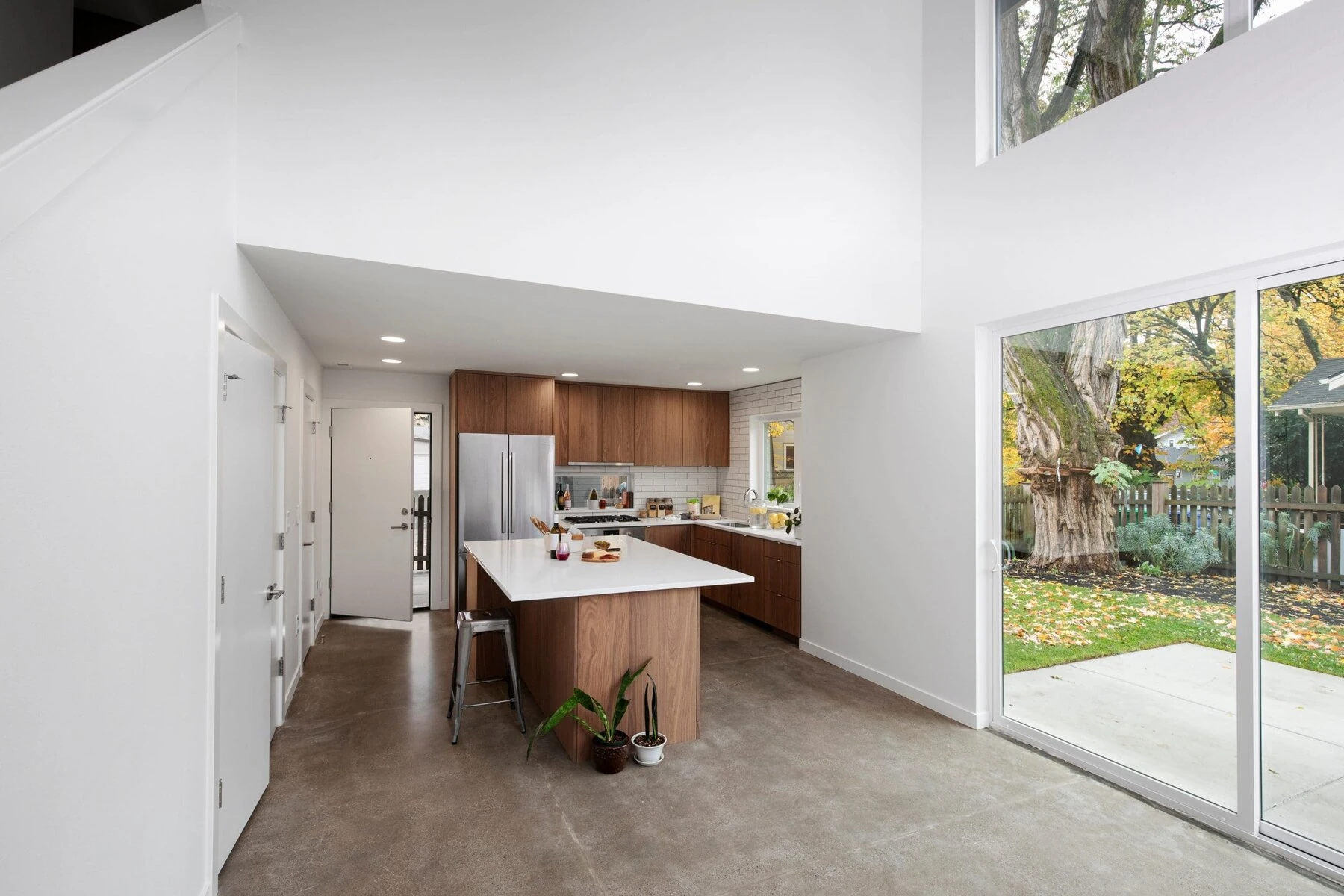
We see it all the time. A homeowner spends tens of thousands on a kitchen remodel—custom cabinetry, quartz countertops, high-end appliances—and then ruins the whole effect with a single recessed light in the center of the ceiling. It casts harsh shadows on the countertops, makes the room feel like an interrogation room, and somehow manages to highlight every single smudge on the stainless steel fridge. That one fixture, placed without thought, becomes the dominant memory of the space. And it’s the most common lighting mistake we encounter: treating light as an afterthought rather than a design element.
Key Takeaways
- One overhead light source creates harsh shadows and flat, uninviting rooms.
- Layering light (ambient, task, accent) solves most lighting problems without expensive fixtures.
- Color temperature matters more than most people realize—2700K–3000K is usually the sweet spot for living spaces.
- Dimmers are not optional; they are the single cheapest way to transform a room’s mood.
- Professional planning before drywall goes up saves thousands in retrofitting costs later.
Table of Contents
Why One Light Source Fails Every Time
There’s a reason every professional photographer uses multiple lights. A single point of light creates high contrast—bright spots and deep shadows. Your eyes constantly adjust, which leads to fatigue. In a living room, that one ceiling fixture turns faces into hollow masks. In a kitchen, it puts your own shadow directly on the cutting board. We’ve walked into countless homes where the owner complains the room feels “cold” or “uninviting,” and the fix is almost never about the fixture itself. It’s about the lack of layers.
The human eye evolved to process light from multiple angles—sunlight bouncing off clouds, reflecting off surfaces, filtering through trees. A single bulb screwed into the center of a vaulted ceiling mimics nothing in nature. It’s the lighting equivalent of eating plain boiled chicken every meal.
The Three-Layer Approach That Actually Works
Ambient Light Sets the Foundation
Ambient light is your base layer. It replaces the sun after dark and fills the room evenly. We prefer indirect sources—wall sconces, cove lighting, or fixtures that bounce light off the ceiling. Direct downlights can work, but only if spaced properly and dimmed. In a standard 10×12 living room, you need at least three to four ambient sources, not one.
The worst mistake we see is relying on a single flush-mount fixture. It creates a “hot spot” directly below it and leaves corners in darkness. Ambient light should feel like daylight on an overcast afternoon—even, soft, and barely noticeable as a source.
Task Light Where You Actually Do Things
Task lighting is the most practical layer and the one most people skip. Think under-cabinet strips in the kitchen, a reading lamp next to the sofa, or a pendant over the kitchen island. The goal is to put 50–100 foot-candles of light exactly where your hands are working.
We’ve seen people install beautiful pendant lights over an island that hang too high and use low-wattage bulbs. They look great in photos but cast useless light. The fixture becomes decoration, not function. A good rule: the bottom of a pendant should be 30–36 inches above the countertop, and the bulb should be at least 800 lumens.
Accent Light Creates Drama
Accent light is the layer that makes a room feel curated. It highlights art, architectural details, or texture—a stone fireplace, a bookshelf, a textured wall. Without it, even expensive finishes look flat. We often recommend track heads or adjustable recessed lights aimed at a specific wall or object. The effect is immediate: the room gains depth and the eye has somewhere to rest.
Color Temperature Is Not a Style Choice
We hear “I want daylight bulbs” more than we’d like. Cool white (4000K–5000K) has its place—garages, workshops, maybe a home gym. But in living spaces, it makes skin look gray and creates a sterile, clinical feel. Warm white (2700K–3000K) mimics the glow of incandescent bulbs and flatters most paint colors and skin tones.
If you’re mixing sources—say, recessed cans and a floor lamp—match the color temperatures within 300K of each other. A 2700K lamp next to a 4000K ceiling light creates visual discord that feels wrong even if you can’t name why. We’ve swapped out bulbs for clients and watched them visibly relax as the room warmed up.
The Dimmable Light Reality Check
Dimmers are cheap—maybe $20 per switch—but they change everything. A fully bright room is appropriate for cleaning or working. At 40% brightness, the same space becomes intimate for dinner or conversation. Without a dimmer, you’re stuck with one setting for every occasion.
There’s a catch, though. Not all LED bulbs are dimmable, and even dimmable ones can flicker or hum if paired with the wrong switch. We’ve learned this the hard way. Always use a compatible dimmer switch and check the manufacturer’s list. Lutron is our go-to brand for reliability. If you’re retrofitting an older home in San Diego, where many houses were built before the 1980s, you may also need to check if your wiring supports modern dimmers. Older aluminum wiring can cause issues.
Common Mistakes We See Repeatedly
Putting Recessed Lights on a Grid
The “can light grid” is a builder default—space them four feet apart in both directions. It works for general illumination but kills any sense of design. The room ends up looking like a parking lot. Instead, place lights where they matter: over the kitchen work triangle, along the perimeter of a living room to wash the walls, or in a hallway to highlight art.
Ignoring the Switch Location
You walk into a dark room and have to cross it to find the switch. We see this in older homes and even some new builds. Three-way switches at every entrance are not a luxury; they’re basic usability. In San Diego, where many homes have open floor plans with multiple entry points, this becomes a daily frustration.
Choosing Fixtures by Photo Alone
A pendant that looks stunning in a showroom or online can be overwhelming in a small dining nook. We’ve installed fixtures that were physically too large for the space, making the room feel cluttered. Measure your ceiling height and table size before buying. A good rule: the fixture diameter should be about half the table width, and the bottom should hang 30–34 inches above the tabletop.
When Professional Help Actually Saves You Money
We’re not saying you can’t swap a light fixture yourself. Most people can. But when it comes to planning a whole-house lighting layout, especially before drywall goes up, hiring a professional pays for itself. A good designer or contractor will account for ceiling height, window placement, furniture layout, and how the light interacts with paint finishes.
We’ve seen DIY layouts that place a light directly over where a sofa will sit, or miss the kitchen island entirely. Fixing those mistakes after drywall means cutting holes, patching, repainting. The cost of a one-hour consultation is less than the drywall repair alone.
At color temperature, we recommend talking to a local builder like Golden Shore Design & Build in San Diego, CA, who can walk through your home and point out where lighting will fall short before you start construction. That kind of on-site, real-world advice saves headaches later.
A Quick Comparison of Common Lighting Approaches
| Approach | What It Costs (Avg) | Best For | Biggest Downside |
|---|---|---|---|
| Single ceiling fixture | $50–$200 | Budget rentals, temporary spaces | Harsh shadows, flat room |
| Recessed grid (6–8 cans) | $800–$1,500 | Even general light | Lacks character, feels commercial |
| Track lighting | $200–$600 | Highlighting art or walls | Can look dated if not chosen carefully |
| Layered system (ambient + task + accent) | $1,500–$4,000 | Any room you live in | Higher upfront cost, requires planning |
The layered system costs more upfront, but it’s the only approach that gives you control over the mood and function of the room. The others are compromises.
When the Advice Doesn’t Apply
Not every room needs three layers. A hallway, for example, works fine with a single sconce or flush-mount light. A closet needs one bright source. And if you’re renting, you probably can’t rewire the place. In those cases, focus on plug-in floor and table lamps that you can take with you. A well-placed floor lamp with a warm bulb and a dimmer plug costs under $100 and can transform a rental living room.
Also, if you have very low ceilings (under eight feet), pendants and chandeliers become impractical. Stick to flush-mounts or semi-flush fixtures that don’t hang into headspace.
The One Thing We’d Do Differently
If we could go back and change one thing in every project we’ve done, it would be installing more switched outlets. A switched outlet lets you plug in a floor lamp and control it from the wall switch. It’s a simple, cheap addition during construction that gives you flexibility forever. Without it, you’re either pulling a chain on a lamp or leaving lights on all day.
Final Thoughts
Lighting is the single most impactful element in a room, and it’s the one most people get wrong. The fix isn’t expensive or complicated. It’s about thinking in layers, matching color temperatures, and using dimmers. If you’re planning a renovation, take the time to map out where you’ll sit, cook, read, and talk. Then put light where those activities happen. It sounds obvious, but you’d be surprised how often it’s overlooked.
And if you’re in San Diego and dealing with the quirks of a 1950s bungalow or a modern condo with open sightlines, talk to someone who has seen those problems before. Golden Shore Design & Build has worked through enough lighting layouts to know what works and what doesn’t in our local climate and housing stock. A quick walkthrough can save you from a room that never feels quite right.
Good light doesn’t call attention to itself. It just makes the room feel better. That’s the goal.
People Also Ask
A common lighting mistake is relying on a single overhead light source, which creates harsh shadows and an uninviting atmosphere. Another frequent error is using the wrong color temperature; for example, cool white bulbs in a living room can feel sterile rather than cozy. Poor placement, such as placing fixtures too high or too low, can also waste light and cause eye strain. To avoid these issues, layer your lighting with ambient, task, and accent options. At Golden Shore Design and Build, we recommend dimmers to control intensity and warm tones for relaxation areas. Always consider the room's function to ensure your lighting enhances both mood and usability.
The 3 lighting rule, often called three-point lighting, is a standard technique in photography and interior design that uses three distinct light sources to create depth and dimension. It consists of a key light, which is the primary and strongest source; a fill light, placed opposite the key to soften shadows; and a back light, positioned behind the subject to separate it from the background. In residential or commercial spaces, this principle helps achieve balanced illumination that highlights architectural features without harsh contrasts. For expert application in your San Diego home, Golden Shore Design and Build can integrate this rule into your lighting plan to enhance both functionality and aesthetic appeal.
The 5-7 light rule is a professional guideline used in bathroom lighting design to create a balanced and flattering illumination. It suggests that for optimal visual comfort and to minimize harsh shadows on the face, you should use a combination of lighting sources positioned at 5 and 7 o'clock angles relative to the mirror. This typically means placing one light fixture on each side of the mirror, rather than relying solely on an overhead light. For a comprehensive understanding of how to apply this and other essential design principles to your project, we recommend reading our internal article titled Mastering The Golden Rule Of Bathroom Layouts. Following this rule helps ensure even light distribution, which is crucial for tasks like shaving or applying makeup.
Gen Z's aversion to overhead lighting stems from a preference for softer, more ambient light that creates a calming and cozy atmosphere. Harsh overhead fixtures, especially fluorescent or bright white LEDs, can feel stark and uninviting, often causing eye strain or headaches. This generation prioritizes comfort and mood in their living spaces, opting for layered lighting with floor lamps, string lights, and dimmable sconces instead. For homeowners in San Diego, Chula Vista, National City, La Mesa and Spring Valley CA, Golden Shore Design and Build can help integrate modern lighting solutions that balance functionality with aesthetic appeal. We recommend using warm-toned bulbs and multiple light sources to achieve a flexible, inviting environment that aligns with contemporary preferences.